Introduction
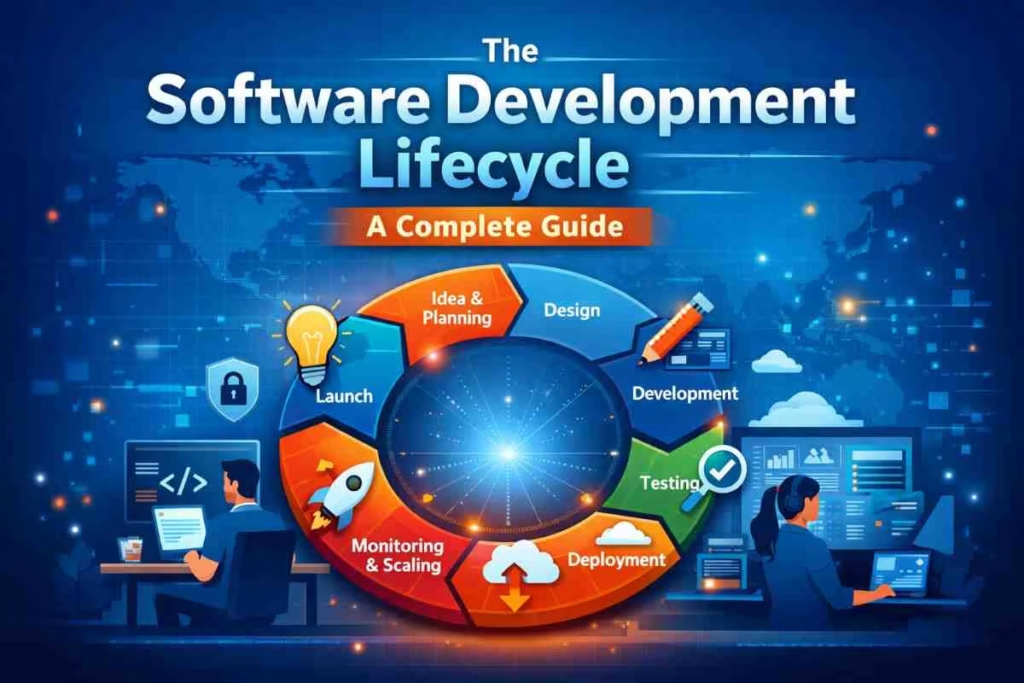
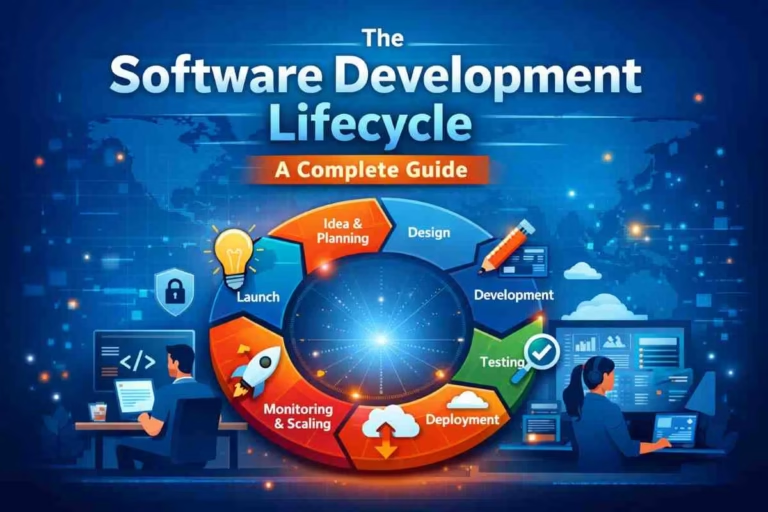
A software development lifecycle (SDLC) is a structured process that takes a software product from idea to development, testing, deployment, and continuous improvement. In modern development, this process is iterative, allowing teams to continuously refine products based on real user feedback.
Today, 71% of organizations use Agile methodologies as part of their SDLC, making it the most widely adopted approach worldwide. This shift reflects how businesses now prioritize flexibility, faster delivery, and continuous improvement over rigid development models.
However, many software projects still fail, not due to coding issues, but because of poor planning, unclear requirements, and the absence of a structured lifecycle. These early-stage gaps often lead to delays, cost overruns, and low user adoption.
At Bytexus, we’ve seen this across real-world projects in industries like FinTech, Healthcare, and Logistics. The success of a product often depends on how well the development lifecycle is planned and executed from the beginning.
A modern SDLC provides a clear framework to reduce risks, control costs, and build scalable software. In this guide, we’ll break down the 7 key stages of a modern SDLC with practical insights to help you build reliable, real-world products.
Key Takeaways
- A software development lifecycle (SDLC) is a structured process used to design, build, test, and deploy software efficiently. Modern SDLC follows an iterative, Agile-driven approach, allowing continuous improvement based on user feedback.
- 71% of organizations use Agile methodologies, making it the dominant SDLC approach worldwide
- A modern SDLC includes 7 key stages: idea validation, planning, design, development, testing, deployment, and monitoring
- Starting with proper validation helps avoid building products that users do not need
- Strong architecture and planning reduce long-term scalability and performance issues
- Continuous testing ensures better quality, security, and reliability
- Deployment is not the final step—ongoing monitoring and scaling are critical for success
- Most software failures happen due to poor early-stage decisions, not development itself
- At Bytexus, a structured SDLC approach is used to reduce risks, improve efficiency, and build scalable software systems aligned with real business needs.
What is a Software Development Lifecycle (SDLC)?
A software development lifecycle (SDLC) is a structured process used to plan, design, develop, test, deploy, and maintain software in a controlled and efficient way. It defines how a software product moves from an initial idea to a fully functional system that delivers real business value.
In modern software development, the SDLC is not a rigid, step-by-step sequence. Instead, it follows an iterative and Agile-driven approach, where teams continuously build, test, and improve the product based on user feedback, performance data, and evolving business requirements.
This modern approach enables businesses to:
- Deliver software faster through iterative development cycles
- Improve product quality with continuous testing and validation
- Adapt quickly to changing requirements and market needs
- Build scalable systems that grow with user demand
In real-world scenarios, the software development lifecycle plays a critical role in reducing project risks. Without a structured SDLC process, teams often face unclear requirements, poor system design, delays in delivery, and costly rework after deployment.
In simple terms, the software development lifecycle is not just about building software—it is about building the right product, in the right way, with a process that supports long-term success.
What Are the 7 Stages of a Modern Software Development Lifecycle?
A modern software development lifecycle (SDLC) consists of 7 key stages that guide a software product from idea to deployment and continuous improvement. Each stage plays a critical role in ensuring the product is scalable, reliable, and aligned with real business needs.
Stage 1: Idea Validation in the Software Development Lifecycle
Idea validation ensures that the software being built solves a real problem and has clear market demand. At this stage, teams define the problem, identify target users, and validate whether the solution is worth building before investing time and resources into development.
In many real-world projects, failure starts here—not in coding, but in assumptions. When businesses skip validation, they often build feature-heavy products that lack real user demand, leading to poor adoption and wasted development costs.
A structured validation process typically includes user research, competitor analysis, and early feedback collection. Teams often develop a Minimum Viable Product (MVP) to test core functionality with real users before committing to full-scale development. This approach reduces risk and provides clarity on what features actually matter.
From a business perspective, this stage directly impacts ROI. A well-validated idea ensures that every feature built later contributes to solving a real user problem.
Key priorities at this stage include:
- Selecting the right technology stack based on use case
- Designing scalable system architecture (monolith vs microservices)
- Planning database structure and data flow
- Defining APIs and integration points
- Setting up cloud infrastructure and DevOps pipelines
Stage 2: Planning & Architecture in the Software Development Lifecycle
Planning and architecture define how the software will be built, scaled, and maintained over time. This stage translates a validated idea into a structured technical plan, ensuring the system can handle real-world usage, future growth, and integration requirements.
At this stage, teams make critical decisions around technology stack, system architecture, database design, APIs, and infrastructure setup. These decisions directly impact performance, scalability, security, and long-term development costs.
In modern software development, architecture is not just about building a working system, it is about building a system that can scale efficiently under increasing users, data loads, and integrations. Poor architectural decisions often lead to performance bottlenecks, expensive rework, and limitations as the product grows.
For example, choosing between monolithic architecture and microservices, selecting the right cloud platform (AWS, Azure, or Google Cloud), and implementing CI/CD pipelines are all part of this stage. These choices determine how quickly the product can evolve and how reliably it performs in production environments.
Another key focus is scalability and security planning. Systems must be designed to handle peak traffic, protect sensitive data, and meet compliance requirements from the beginning—not after deployment.
In large-scale and enterprise projects, an architecture-first approach is often used to define system structure before development begins. This reduces technical debt, improves system stability, and ensures long-term scalability—especially in industries with high data sensitivity and complex workflows.
Key priorities at this stage include:
- Selecting the right technology stack based on use case
- Designing scalable system architecture (monolith vs microservices)
- Planning database structure and data flow
- Defining APIs and integration points
- Setting up cloud infrastructure and DevOps pipelines
Stage 3: UI/UX Design in the Software Development Lifecycle
UI/UX design focuses on how users interact with the product and how easily they can achieve their goals. At this stage, teams translate business requirements into intuitive user flows, wireframes, and interactive prototypes before development begins.
In modern software development, design is not just about visual appearance—it directly impacts user adoption, retention, and conversion rates. Even a technically strong product can fail if users find it confusing, slow, or difficult to navigate.
The process typically starts with user journey mapping, where teams define how users move through the product step by step. This is followed by wireframes and prototypes that simulate real interactions, allowing early feedback before any code is written. This approach helps identify usability issues early and reduces costly changes during development.
A key focus at this stage is simplicity and clarity. Users should be able to complete tasks with minimal effort, without needing instructions. Poor UI/UX often leads to high drop-offs, low engagement, and negative user experience—especially in competitive markets.
Modern UI/UX design also considers responsiveness, accessibility, and performance across devices. With users accessing applications from mobile, desktop, and tablets, consistency in experience becomes critical.
Key priorities at this stage include:
- Designing clear user flows based on real use cases
- Creating wireframes and interactive prototypes
- Ensuring intuitive navigation and minimal friction
- Optimizing for mobile responsiveness and accessibility
- Validating design decisions through user feedback
Stage 4: Development in the Software Development Lifecycle
The development stage is where the actual software is built based on the defined architecture and approved designs. Instead of building everything at once, modern software development follows an Agile and iterative approach, where features are developed in smaller cycles called sprints.
This approach allows teams to release incremental updates, gather feedback early, and continuously improve the product. It also reduces the risk of large-scale failures, as issues can be identified and resolved during development rather than after completion.
During this stage, developers work with version control systems (such as Git), collaborative tools (like Jira), and CI/CD pipelines to ensure smooth and efficient workflows. Code is written, reviewed, and integrated regularly to maintain consistency and quality across the system.
A key advantage of iterative development is flexibility. As business requirements evolve or new insights emerge, teams can adapt without disrupting the entire project. This is especially important in fast-changing industries where user expectations and market conditions shift quickly.
Another important aspect is code quality and maintainability. Writing clean, modular, and well-documented code ensures that the system can be updated, scaled, and maintained efficiently over time. Poor coding practices at this stage often lead to technical debt, making future updates slower and more expensive.
Key priorities at this stage include:
- Breaking development into smaller, manageable sprints
- Using version control for collaboration and code management
- Implementing CI/CD pipelines for continuous integration
- Writing well-structured, modular code that is easy to scale and maintain
- Adapting to feedback and evolving requirements
Stage 5: Testing & Quality Assurance in the Software Development Lifecycle
Testing and quality assurance (QA) ensure that the software works reliably, performs efficiently, and meets user expectations before and after release. In a modern software development lifecycle (SDLC), testing is not a final step—it runs continuously alongside development.
The goal of this stage is to identify and fix issues early, before they impact users. This includes testing for functionality, performance, security, and usability to ensure the system behaves correctly under real-world conditions.
Modern QA processes combine manual testing and automated testing. Automated tests help validate core functionality quickly and repeatedly, while manual testing focuses on user experience and edge cases that automation may miss. This combination improves coverage and reduces the chances of critical failures.
A key focus is performance and load testing, especially for applications expected to handle high traffic or large datasets. Without proper testing, systems may fail under peak usage, leading to downtime and poor user experience.
Security testing is equally important. Applications must be tested for vulnerabilities to prevent data breaches and ensure compliance with industry standards.
Continuous testing also supports faster development cycles. By integrating testing into CI/CD pipelines, teams can detect issues early and maintain consistent quality throughout the development process.
Key priorities at this stage include:
- Performing functional, performance, and security testing
- Combining automated and manual testing approaches
- Identifying bugs early in the development cycle
- Testing under real-world conditions and peak loads
- Ensuring system reliability, security, and usability
Stage 6: Deployment in the Software Development Lifecycle
Deployment is the stage where the software is released into a live environment and made available to users. In a modern software development lifecycle (SDLC), deployment is not a one-time event—it is a controlled, repeatable process designed to ensure stability, minimal downtime, and seamless user experience.
A successful deployment strategy focuses on reliability and risk reduction. Instead of releasing large updates all at once, modern teams use continuous integration and continuous deployment (CI/CD) pipelines to deliver smaller, incremental updates. This reduces the chances of major failures and allows faster recovery if issues occur.
Advanced deployment strategies such as blue-green deployment, rolling updates, and canary releases are commonly used to minimize disruption. These approaches allow teams to release updates gradually, test them in real environments, and roll back quickly if needed.
Another critical aspect is environment management. Ensuring consistency between development, staging, and production environments helps prevent unexpected issues during release. Without this alignment, software that works in testing may fail in production.
Poor deployment practices can directly impact user experience. Downtime, bugs in live systems, or failed updates can lead to loss of user trust and business revenue. That is why deployment must be carefully planned, monitored, and executed with precision.
Key priorities at this stage include:
- Using CI/CD pipelines for automated and reliable releases
- Implementing safe deployment strategies (blue-green, canary, rolling updates)
- Maintaining consistency across environments
- Monitoring system performance during and after release
- Ensuring minimal downtime and quick rollback capability
Stage 7: Monitoring & Scaling in the Software Development Lifecycle
Monitoring and scaling ensure that the software continues to perform reliably after deployment and adapts as user demand grows. In a modern software development lifecycle (SDLC), this stage is ongoing and plays a critical role in long-term product success.
Once the software is live, teams continuously track system performance, user behavior, error rates, and infrastructure usage. This data helps identify issues early, optimize performance, and make informed decisions about future improvements.
Real-world usage often reveals gaps that are not visible during development or testing. Monitoring allows teams to detect these issues quickly—whether it’s slow response times, unexpected errors, or bottlenecks under high traffic.
Scaling becomes essential as the user base grows. Systems must handle increased load without affecting performance. This often involves horizontal scaling (adding more servers), vertical scaling (increasing system capacity), and optimizing databases and APIs to handle higher demand efficiently.
Another key focus is continuous improvement. Based on analytics and feedback, teams release updates, enhance features, and improve user experience over time. This ensures the product remains relevant and competitive in a changing market.
Ignoring this stage can lead to performance degradation, system failures, and poor user experience as demand increases.
Key priorities at this stage include:
- Tracking system performance, availability, and overall operational health
- Tracking user behavior and usage patterns
- Identifying and fixing issues in real time
- Scaling infrastructure based on demand
- Continuously improving features and performance
What Are the Most Common Mistakes in the Software Development Lifecycle?
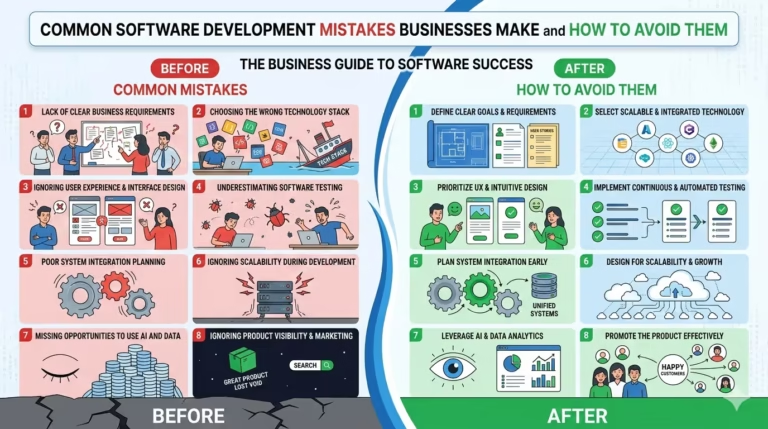
Even with a structured software development lifecycle (SDLC), many projects fail due to avoidable mistakes. These issues often originate in the early stages and compound over time, leading to delays, increased costs, and poor product performance.
Below are the most common mistakes businesses make during the software development lifecycle—and how they impact real-world outcomes.
1. Starting Development Without Proper Idea Validation
One of the most critical mistakes is jumping into development without confirming whether the product solves a real problem. Without validation, teams build features based on assumptions rather than actual user needs.
This often results in low adoption, wasted development effort, and products that fail to gain traction in the market.
2. Overbuilding Instead of Launching an MVP
Many teams try to build a fully featured product from the beginning instead of starting with a Minimum Viable Product (MVP). This increases development time, cost, and complexity.
A better approach is to launch a simple version, gather feedback, and improve iteratively. This reduces risk and accelerates time to market.
3. Weak Planning and Poor System Architecture
Inadequate planning and rushed architectural decisions create long-term scalability and performance issues. Systems that are not designed for growth often struggle under increased user demand.
Fixing architectural issues later is significantly more expensive than addressing them during the planning stage.
4. Treating Testing as a Final Step
Testing is often delayed until the end of development, which increases the risk of bugs and failures in production. Without continuous testing, issues remain undetected until they impact users.
Modern SDLC practices integrate testing throughout the development lifecycle to ensure consistent quality.
5. Ignoring User Experience (UI/UX)
A technically strong product can still fail if users find it difficult to use. Poor UI/UX design leads to confusion, high drop-off rates, and low engagement.
User experience should be prioritized from the design stage, not treated as an afterthought.
6. Lack of Clear Communication and Alignment
Misalignment between stakeholders, developers, and business teams often leads to confusion, delays, and incorrect implementation of features.
Clear documentation, defined goals, and regular communication are essential for smooth execution.
7. No Post-Deployment Monitoring or Scaling Plan
Many teams treat deployment as the final step and fail to monitor performance or plan for scaling. This leads to performance issues, downtime, and inability to handle growth.
Ongoing monitoring and regular optimization are critical for sustained performance and growth.
You may also like to read: Common Software Development Mistakes Businesses Make and How to Avoid Them
Why Avoiding These Mistakes Matters
Each of these mistakes directly impacts time, cost, and product success. In real-world projects, most failures are not caused by lack of technical capability—but by gaps in process, planning, and execution.
Avoiding these mistakes allows businesses to:
- Minimize development risks and avoid unplanned expenses
- Improve product quality and reliability
- Deliver faster and adapt to market changes
- Build software that performs well in real-world conditions
How Bytexus Delivers Scalable Software from Idea to Deployment
Building successful software is not just about writing code—it requires a structured, execution-driven approach across every stage of the software development lifecycle (SDLC). From idea validation to long-term scaling, each phase must align with real business goals, user needs, and technical performance.
At Bytexus, software development is approached as a complete lifecycle system, not isolated development tasks. The focus is on building solutions that are not only functional at launch but also scalable, secure, and adaptable as the business grows.
A Structured, Execution-Driven Approach
Instead of following rigid or generic models, Bytexus applies a practical, architecture-first methodology:
- Discovery & Validation → Ensuring business objectives are aligned with actual user requirements
- Architecture Planning → Designing scalable and secure system foundations
- Iterative Development → Building in Agile cycles for faster delivery
- Continuous Testing → Ensuring quality, performance, and reliability
- Controlled Deployment → Releasing stable, production-ready systems
- Ongoing Monitoring & Scaling → Optimizing performance based on real usage
This structured approach ensures that every stage of the lifecycle contributes to long-term product success, not just short-term delivery.
Built for Real-World Performance
In many projects, software works in development environments but fails under real-world conditions. Bytexus focuses on building systems that perform reliably in production by prioritizing:
- Scalable architecture that handles growth
- Secure systems aligned with compliance standards
- Optimized performance under real user loads
- Adaptive systems designed to evolve with changing business requirements
This reduces technical debt, minimizes risk, and ensures consistent performance over time.
Industry-Focused Execution
Bytexus works with businesses across industries such as FinTech, Healthcare, Logistics, and more—where requirements are complex and performance expectations are high. This industry experience enables better decision-making across architecture, integrations, and compliance.
Why This Approach Matters
A structured and well-executed software development lifecycle directly impacts:
- Time to market
- Development cost efficiency
- Product scalability and performance
- User adoption and retention
The difference between software that fails and software that scales often comes down to how well the lifecycle is executed—not just how well the code is written.
Ready to Build Your Software Product?
If you’re planning to develop a scalable and reliable software solution, following the right development lifecycle is critical.
Partner with Bytexus to build software that is designed for performance, scalability, and long-term growth.
Conclusion
A well-defined software development lifecycle (SDLC) is the foundation of building reliable, scalable, and high-performing software. From idea validation to deployment and continuous scaling, each stage plays a critical role in ensuring that the final product delivers real business value.
Modern software development is no longer about following rigid processes—it is about adopting an iterative, Agile-driven approach that allows continuous improvement, faster delivery, and better alignment with user needs.
Businesses that follow a structured SDLC can reduce risks, control development costs, and build products that perform effectively in real-world conditions. On the other hand, skipping key stages or rushing decisions often leads to scalability issues, poor user adoption, and long-term technical challenges.
In practical terms, the success of a software product depends not just on development, but on how well each stage of the lifecycle is planned and executed.
If you are planning to build or scale a digital product, focusing on the right development lifecycle approach is the first step toward long-term success.
What is a software development lifecycle (SDLC) in simple terms?
A software development lifecycle (SDLC) is a defined framework that guides how software is planned, built, tested, and delivered from initial concept to ongoing improvements. It includes stages such as planning, design, development, testing, and maintenance. In modern development, SDLC follows an iterative model, enabling teams to refine and enhance the product continuously based on user feedback and performance insights.
What are the 7 stages of a modern software development lifecycle?
A modern software development lifecycle consists of seven key stages: idea validation, planning and architecture, UI/UX design, development, testing and quality assurance, deployment, and monitoring with scaling. These stages work together to ensure the software is reliable, scalable, and aligned with business goals.
Why is the software development lifecycle important for businesses?
The software development lifecycle helps businesses reduce risks, control development costs, and improve product quality. By following a structured process, teams can avoid common mistakes such as poor planning, weak architecture, and lack of testing, which often lead to project delays and failures.
What is the difference between traditional SDLC and modern SDLC?
Traditional SDLC follows a linear, step-by-step process where each stage is completed before moving to the next. In contrast, modern SDLC uses an iterative and Agile approach, where development, testing, and improvements happen continuously. This allows faster delivery, better flexibility, and quicker adaptation to changing requirements.
What is Agile in software development lifecycle?
Agile is a development approach used within the software development lifecycle that focuses on iterative development, collaboration, and continuous feedback. Instead of building the entire product at once, teams develop features in small cycles (sprints), allowing faster releases and ongoing improvements.
How do you choose the right SDLC model for a project?
Choosing the right SDLC model depends on factors such as project complexity, timeline, budget, and flexibility requirements. Agile is suitable for projects with evolving requirements, while more structured models may work better for projects with clearly defined scopes and strict compliance needs.
What is a Minimum Viable Product (MVP) in SDLC?
A Minimum Viable Product (MVP) is a simplified version of a software product that includes only the core features needed to solve the main problem. It is used to test the idea quickly, gather user feedback, and make improvements before investing in full-scale development.
How long does the software development lifecycle take?
The duration of the software development lifecycle depends on the complexity of the project, features, and team size. Simple applications may take a few months, while complex enterprise systems can take several months or longer. Modern SDLC approaches help reduce timelines through iterative development and continuous delivery.
What happens after software deployment?
After deployment, the software enters the monitoring and scaling stage. Teams track performance, fix issues, optimize features, and scale the system based on user demand. Continuous monitoring ensures the product remains reliable, secure, and aligned with user needs.
What are the most common challenges in software development lifecycle?
Common challenges include unclear requirements, poor planning, weak system architecture, lack of testing, and misalignment between teams. These issues can lead to delays, increased costs, and poor product performance if not addressed early in the lifecycle.