AI in business growth is transforming how organizations scale and compete.Businesses that do not adopt modern technologies risk falling behind competitors that scale faster with smarter systems. In today’s digital-first environment, growth depends on how effectively organizations use technology to improve efficiency, decision-making, and scalability.
Artificial intelligence, cloud computing, and automation have become essential for modern business growth. They help businesses use data in real time, build flexible systems, and streamline operations while reducing costs and complexity.
Across industries like FinTech, Healthcare, Logistics, and Retail, these technologies are enabling companies to build scalable and resilient operations. This shift is no longer optional but necessary for long-term growth and competitiveness.
Key Takeaways
- Modern business growth focuses on scalability, efficiency, and data-driven decision-making
- Artificial intelligence helps businesses analyze data, predict trends, and improve customer experience
- Cloud computing enables flexible infrastructure, reduces costs, and supports business expansion
- Automation improves efficiency by reducing manual work and ensuring consistent processes
- Combining AI, cloud, and automation creates a connected system that improves performance and speed
- These technologies are widely used across industries like FinTech, Healthcare, Logistics, and Manufacturing
- Businesses need proper planning, integration, and the right technology partner for successful adoption
- Strategic implementation helps achieve long-term growth and competitive advantage
What is Modern Business Growth
Modern business growth goes beyond increasing revenue. It focuses on building scalable, efficient, and adaptable systems that support long-term success in a digital environment.
Unlike traditional growth, which depends on expanding infrastructure or workforce, modern growth is driven by technology. Businesses use data, cloud platforms, and automation to scale operations without significantly increasing costs and to respond quickly to market demands.
For example, cloud-based systems allow companies to expand globally without heavy infrastructure, while data-driven tools improve decision-making and operational efficiency.
This approach is closely linked to digital transformation, where technologies such as artificial intelligence, cloud computing, and automation are integrated into core business processes. It enables organizations to operate more efficiently, adapt faster, and remain competitive.
Role of AI in Business Growth
Artificial intelligence plays a critical role in enabling faster and more accurate decision-making. Businesses use AI to analyze large datasets, identify patterns, and generate insights that improve operations and strategy.
Predictive analytics is one of the most valuable applications of AI. It helps businesses forecast demand, detect risks, and optimize performance. For example, FinTech companies use AI for fraud detection, while Healthcare organizations use it for faster data analysis and improved decision support.
AI also enhances customer experience through personalization, recommendations, and automated support systems. When integrated into business workflows, it reduces manual effort and improves accuracy.
Key benefits of AI include:
- Faster and data-driven decision-making
- Better prediction of trends and risks
- Improved customer experience
- Increased operational efficiency
AI is becoming essential for businesses that want to scale efficiently and stay competitive.
Role of Cloud Computing in Business Growth
Cloud computing allows businesses to scale operations, reduce infrastructure costs, and improve flexibility. Instead of relying on physical servers, organizations can access computing resources on demand and adjust capacity based on their needs.
One of the biggest advantages is scalability. Businesses can expand operations, support remote teams, and handle increased workloads without major infrastructure changes. For example, logistics companies use cloud platforms for real-time tracking, while tech companies rely on cloud environments for faster deployment and reliability.
Cloud platforms also improve collaboration by enabling access to data and applications from anywhere. Pay-as-you-use pricing models further help businesses manage costs efficiently.
Core advantages of cloud computing include:
- Scalable infrastructure without heavy upfront investment
- Cost optimization through usage-based pricing
- Improved accessibility and collaboration
- Reliable data storage and performance
Cloud computing forms the foundation for flexible and growth-ready digital systems.
Role of Automation in Business Growth
Automation helps businesses improve efficiency by reducing manual effort and ensuring consistent execution of tasks. It is widely used for processes such as data entry, workflow management, and reporting.
One key advantage of automation is consistency. Businesses can minimize errors and maintain standardized processes across operations. For example, in manufacturing, automation improves production efficiency, while in logistics, it enables faster order processing.
Automation also increases productivity by allowing tasks to run continuously without delays. This leads to faster execution and better resource utilization.
Key advantages of automation include:
- Reduced manual work and fewer errors
- Faster execution of repetitive tasks
- Improved process efficiency
- Better use of team resources
Automation is essential for businesses aiming to scale efficiently and maintain reliable operations.
How AI, Cloud, and Automation Work Together
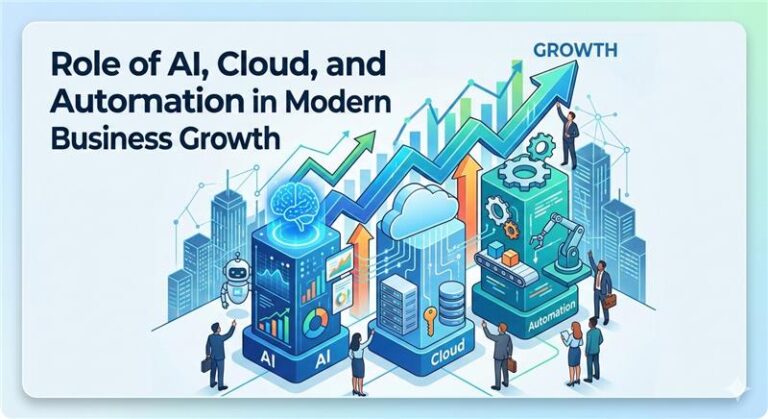
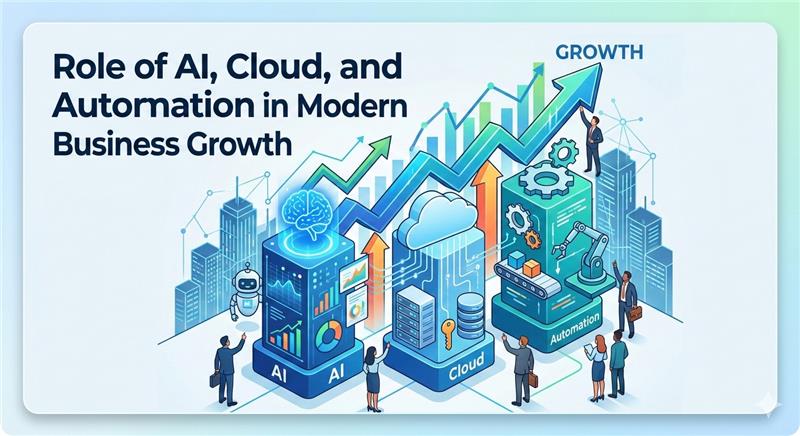
The real impact on business growth comes when these technologies are used together as a connected system. Each plays a different role, but their integration creates a more efficient and scalable environment.
Cloud platforms provide the infrastructure to store and manage data. AI analyzes that data to generate insights and support decision-making. Automation then executes actions based on those insights, ensuring faster and more accurate operations.
For example, a business can collect real-time data through cloud systems, apply AI to predict demand, and automate workflows such as order processing or customer communication. This integrated approach improves speed, accuracy, and efficiency.
Key Benefits for Businesses
The combined use of AI, cloud computing, and automation helps businesses improve performance, reduce costs, and scale efficiently.
One major advantage is faster decision-making through real-time data and insights. Businesses can respond quickly to market changes while automation ensures smooth execution.
Cost efficiency is another key benefit, as cloud reduces infrastructure expenses and automation minimizes manual effort. This allows better resource management.
Scalability also becomes easier, enabling businesses to grow and handle demand without major system changes.
Key benefits include:
- Faster and more accurate decision-making
- Reduced operational and infrastructure costs
- Scalable systems that support growth
- Improved productivity and efficiency
Industry Use Cases
The impact of AI, cloud, and automation is clearly visible across industries that require scalability and efficiency.
In FinTech, businesses use AI for fraud detection, cloud for secure data management, and automation for faster transactions. In Healthcare, these technologies improve diagnostics, ensure secure records, and streamline workflows.
In Transportation and Logistics, AI enables route optimization, cloud supports real-time tracking, and automation improves operational efficiency. In Manufacturing, businesses use AI for predictive maintenance, automation for production efficiency, and cloud systems for seamless data flow.
These examples show how organizations use technology to improve performance, reduce costs, and scale effectively.
Key Challenges in Adopting AI, Cloud, and Automation
Successfully implementing these technologies depends on a well-defined strategy and a structured approach. One major challenge is integrating new systems with existing infrastructure while maintaining data consistency.
Data security and compliance are also critical, especially for industries handling sensitive information. Businesses must ensure proper security measures when using cloud platforms.
Another challenge is the skill gap. Implementing AI, cloud, and automation requires expertise, which may require support from experienced teams.
Proper planning and phased implementation are essential to avoid disruption and ensure successful adoption.
Future Trends in AI, Cloud, and Automation
The future of business growth is moving toward deeper integration of AI, cloud, and automation. Businesses are building more intelligent and connected systems that rely on real-time data.
AI-powered cloud platforms are becoming more common, enabling faster data processing and decision-making. Hyperautomation is also expanding, allowing businesses to automate end-to-end processes.
Organizations are increasingly focusing on industry-specific solutions that improve speed, security, and scalability. These trends will continue to shape how businesses grow and compete.
How Businesses Can Get Started with AI, Cloud, and Automation
Businesses should start by identifying areas where these technologies can create the most impact, such as operations or customer experience.
Choosing the right solutions and building scalable systems is the next step. Ensuring proper integration helps improve efficiency and avoid data silos.
Starting with a focused implementation allows businesses to test and scale gradually. Working with an experienced technology partner can further ensure smooth execution and long-term success.
Steps to get started:
- Identify high-impact areas
- Select the right technologies
- Build scalable systems
- Start small and scale gradually
Conclusion
Artificial intelligence, cloud computing, and automation are no longer optional for modern businesses. They have become essential for improving efficiency, scaling operations, and staying competitive in a rapidly evolving digital landscape.
By using AI for intelligent insights, cloud for scalable infrastructure, and automation for efficient execution, businesses can build systems that support long-term growth and adaptability.
At Bytexus, we help businesses design and implement secure, scalable, and high-performance digital solutions tailored to their goals. With the right strategy and technology approach, organizations can transform operations and unlock sustainable growth.
Frequently Asked Questions (FAQs)
What is the role of AI in business growth?
Artificial intelligence helps businesses analyze large volumes of data, identify patterns, and make faster decisions. It supports predictive analytics, improves operational efficiency, and enhances customer experience through personalization and automation.
How does cloud computing support business growth?
Cloud computing allows businesses to scale infrastructure based on demand, reduce costs associated with physical servers, and enable remote access to data and applications. It improves flexibility, collaboration, and overall system reliability.
What are business automation tools and why are they important?
Business automation tools streamline repetitive tasks such as data entry, workflows, and reporting. They reduce manual errors, improve process efficiency, and allow teams to focus on strategic activities that drive growth.
How do AI, cloud, and automation work together?
Cloud platforms store and manage data, AI analyzes that data to generate insights, and automation executes tasks based on those insights. Together, they create faster, more efficient, and scalable business operations.
Why are AI, cloud computing, and automation important for digital transformation?
These technologies enable businesses to improve efficiency, reduce operational costs, and scale effectively. They form the foundation of digital transformation by helping organizations become more agile and data-driven.
Which industries benefit the most from these technologies?
Industries such as FinTech, Healthcare, Transportation and Logistics, Manufacturing, and Retail benefit significantly. These sectors use AI, cloud, and automation to improve accuracy, efficiency, and scalability.
What challenges do businesses face when adopting these technologies?
Common challenges include u003ca href=u0022https://bytexus.com/services/system-integration-services/u0022u003esystem integrationu003c/au003e, data security concerns, lack of skilled resources, and initial planning complexity. Addressing these with a structured approach ensures successful implementation.
How can businesses get started with AI, cloud, and automation?
Businesses should begin by identifying high-impact areas, selecting the right technologies, and implementing solutions in phases. Partnering with an experienced technology provider like Bytexus can help ensure smooth execution and long-term success.