In today’s fast-evolving digital landscape, businesses are constantly investing in technology to improve efficiency, enhance customer experience, and scale operations. However, one of the most critical decisions often gets overlooked at the beginning — choosing the right software architecture for business.
Should you build a web application, invest in a mobile app, or move toward a cloud-based solution?
Each option offers unique advantages, but the wrong choice can lead to higher costs, limited scalability, and operational inefficiencies. For startups and enterprises alike, selecting the right architecture is not just a technical decision — it directly impacts growth, performance, and long-term success.
Modern businesses no longer operate in a one-size-fits-all environment. Customer expectations, market competition, and digital transformation demands require solutions that are flexible, scalable, and aligned with specific business goals.
In this blog, we’ll break down the key differences between web, mobile, and cloud applications, explore when to choose each, and provide a practical framework to help you make the right decision for your business.
Key Takeaway
- Choosing the right software architecture for business directly impacts performance, scalability, and long-term growth
- Web applications are ideal for accessibility, cost efficiency, and multi-device usage
- Mobile applications are best for user engagement, real-time interaction, and device-based features
- Cloud-based applications provide scalability, flexibility, and strong integration capabilities
- The right choice depends on business goals, target users, budget, and future growth plans
- Ignoring factors like scalability, integration, and security can lead to costly mistakes
- Many businesses achieve better results by combining web, mobile, and cloud architectures
- A well-planned architecture reduces long-term costs and ensures your system can evolve with your business
What is Software Architecture in Business?
Software architecture for business refers to the overall structure and design of a software system, including how different components interact, how data flows, and how the system supports performance, scalability, and security requirements.
It is not just a technical blueprint but a strategic foundation that determines how efficiently a system can handle users, adapt to growth, and integrate with other technologies. A well-defined architecture ensures that the software remains reliable, maintainable, and capable of evolving with changing business needs.
For businesses, software architecture plays a direct role in operational success. It affects how quickly a product can be developed, how easily it can scale, and how securely it can manage data and transactions. Poor architectural decisions often lead to system limitations, increased costs, and performance issues over time.
Modern businesses require architectures that are flexible and scalable. Whether it is a web application, mobile platform, or cloud-based system, the architecture must align with business goals and support long-term growth.
Web vs Mobile vs Cloud Applications: Key Differences Explained
Before choosing the right architecture, it’s important to understand how web, mobile, and cloud applications differ in terms of functionality, use cases, and business impact.
Web Applications
Web applications run on web browsers and do not require installation. Users can access them through the internet using any device, making them highly flexible for business operations.
They are commonly used for dashboards, CRM systems, portals, and SaaS platforms.
Advantages:
- Accessible from any device with a browser
- No installation required
- Easier updates and maintenance
- Cost-effective development
Limitations:
- Limited access to device features
- Requires internet connectivity
- Performance may be lower than native apps in some cases
Mobile Applications
Mobile applications are built specifically for smartphones and tablets. They can be developed as native apps (iOS or Android) or cross-platform solutions.
These apps are ideal for businesses that need strong user engagement, real-time interactions, or access to device features like GPS and notifications.
Advantages:
- High performance and speed
- Better user experience
- Access to device hardware (camera, GPS, notifications)
- Can support offline functionality
Limitations:
- Higher development and maintenance costs
- Requires installation
- Platform-specific development may be needed
Cloud-Based Applications
Cloud-based applications are hosted on remote servers and accessed via the internet. These applications are designed for scalability, flexibility, and real-time data access.
They are widely used in enterprise systems, SaaS platforms, and applications that require collaboration and continuous availability.
Advantages:
- Highly scalable and flexible
- Accessible from anywhere
- Supports real-time collaboration
- Lower infrastructure management
Limitations:
- Depends on internet connectivity
- Ongoing cloud or subscription costs
- Requires strong security and compliance practices
Key Factors to Consider Before Choosing the Right Architecture
Choosing between web, mobile, and cloud applications is a strategic business decision, not just a technical one. The right software architecture for business should align with your operational goals, user expectations, and long-term scalability requirements.
Below are the most important factors businesses should evaluate before making a decision.
Business Goals and Use Case
Start by identifying the primary purpose of your software.
- Web applications are ideal for broad accessibility and centralized platforms
- Mobile applications are suitable for high user engagement and real-time interaction
- Cloud-based applications are best for scalable, data-driven, and enterprise-level systems
Your architecture should directly support your core business model and growth objectives.
Target Audience and User Behavior
Understanding how users will interact with your application is critical.
- Desktop-focused users typically prefer web applications
- Mobile-first users expect seamless app experiences
- Businesses with distributed teams benefit from cloud-based access
If your users require mobility, offline access, or device-specific features, mobile applications may be the right choice.
Budget and Total Cost of Ownership
Cost is not limited to initial development. It includes maintenance, updates, and infrastructure.
- Web applications are generally more cost-effective to build and maintain
- Mobile applications often require higher investment, especially for multiple platforms
- Cloud solutions involve ongoing costs but reduce infrastructure management
A clear understanding of long-term cost helps avoid unexpected financial strain.
Scalability and Future Growth
As your business grows, your software must handle increased users, data, and complexity.
Cloud-based architectures are designed for scalability and flexibility, making them suitable for businesses planning rapid expansion. Web and mobile applications can also scale, but they often require additional infrastructure planning.
Integration and Ecosystem Compatibility
Modern software rarely operates in isolation.
Your application may need to integrate with:
- CRM systems
- Payment gateways
- Analytics tools
- Third-party APIs
Cloud-based architectures typically offer better support for seamless integrations and real-time data exchange.
Security and Compliance Requirements
Security is essential, especially for industries handling sensitive data.
Businesses must consider:
- Data protection standards
- Regulatory compliance such as GDPR or HIPAA
- Secure authentication and access control
Choosing the right architecture ensures that security is built into the system from the ground up.
Maintenance, Updates, and Operational Efficiency
Long-term success depends on how easily your software can be maintained and updated.
- Web applications allow centralized updates
- Mobile applications require version updates through app stores
- Cloud platforms support continuous deployment and real-time updates
Efficient maintenance reduces downtime and improves overall system performance.
Web vs Mobile vs Cloud Applications – Which One Fits Your Business Model?
Choosing between web, mobile, and cloud is not about features alone. It depends on how your business operates, how users interact with your product, and how you plan to scale.
The comparison below helps you evaluate each option based on real business requirements.
The following comparison highlights how each architecture performs across key business factors.
Comparison Across Key Decision Factors
| Criteria | Web Applications | Mobile Applications | Cloud-Based Applications |
| Best For | Platforms needing wide accessibility | User-centric, engagement-driven apps | Scalable, data-heavy, enterprise systems |
| Access | Browser-based, no install | App installation required | Internet-based, multi-device access |
| User Experience | Consistent across devices | Highly optimized and interactive | Depends on frontend layer |
| Performance | Good for most use cases | High (especially native apps) | High with scalable backend |
| Cost | Lower development cost | Higher (multi-platform development) | Ongoing infrastructure cost |
| Scalability | Limited compared to cloud | Moderate | High and flexible |
| Maintenance | Easy and centralized | Requires updates per platform | Continuous updates and deployment |
| Integrations | Moderate | Moderate | Strong (API-first ecosystem) |
How to Choose Between Web, Mobile, and Cloud Applications
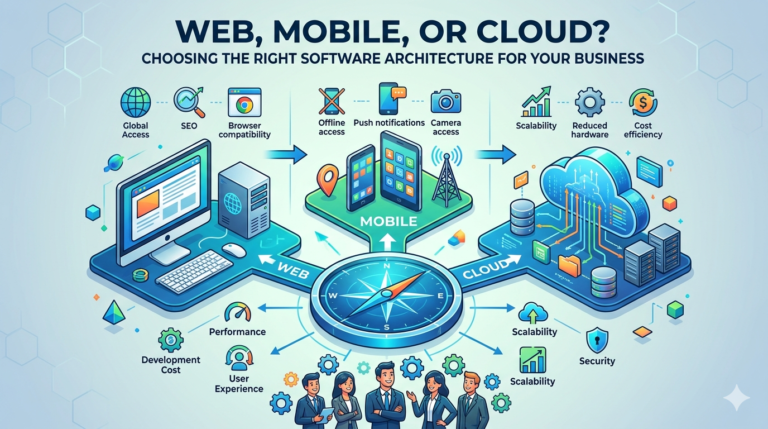
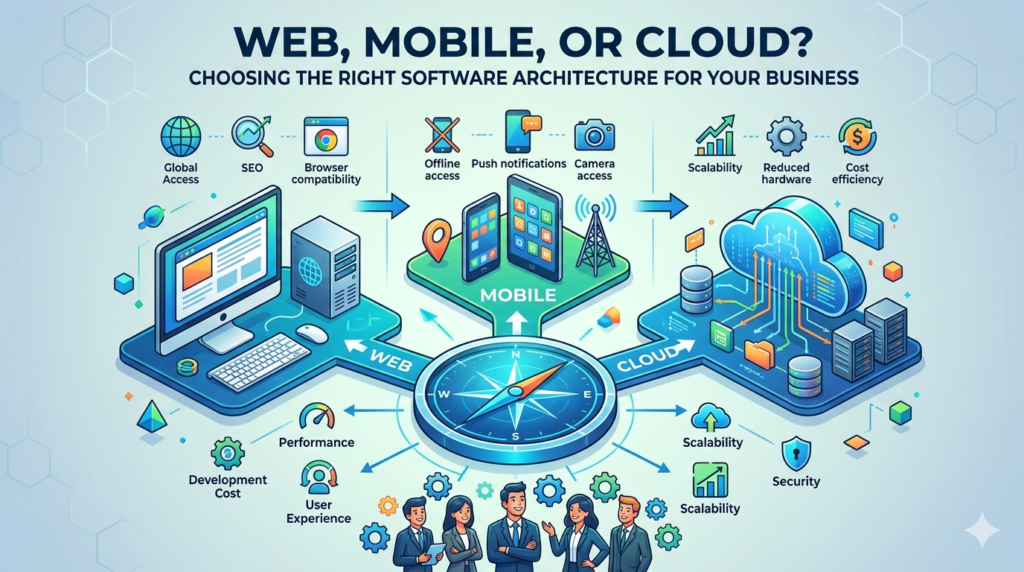
Web applications are commonly selected when the goal is to build a platform that is easily accessible across devices without increasing development complexity. They are practical for admin panels, dashboards, marketplaces, and SaaS frontends where reach and ease of use matter more than deep device interaction.
Mobile applications are chosen when user engagement is the priority. If your business depends on frequent user interaction, push notifications, real-time updates, or device features like GPS and camera, mobile apps provide a more controlled and optimized experience.
Cloud-based applications are selected when the business requires scalability, centralized data management, and system flexibility. They are especially relevant for platforms handling large volumes of data, multi-user environments, or integrations across multiple systems.
Practical Decision Approach
Instead of choosing one in isolation, businesses often combine these architectures based on their needs.
For example:
- A cloud-based backend to manage data and scalability
- A web application for admin and operations
- A mobile application for end-user engagement
This approach allows businesses to balance performance, accessibility, and scalability without limitations.
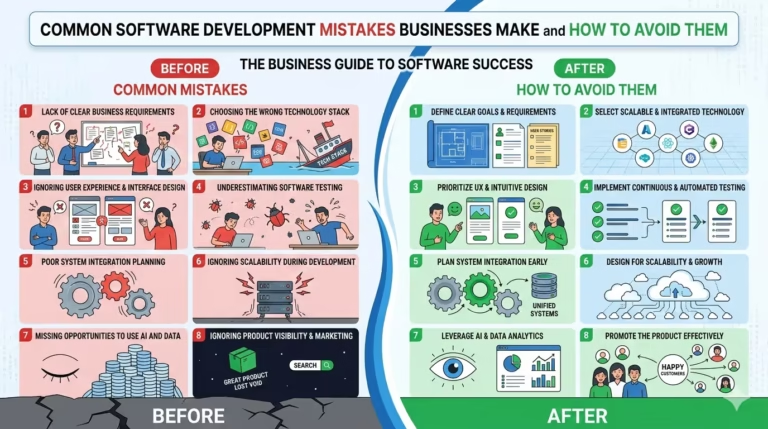
Common Mistakes Businesses Make When Choosing Software Architecture
Selecting the wrong architecture can lead to long-term challenges that impact performance, scalability, and overall business growth. Many businesses make avoidable mistakes by focusing on short-term needs instead of long-term strategy.
Below are the most common mistakes to watch out for when choosing the right software architecture for business.
Choosing Based on Trends Instead of Business Needs
One of the most common mistakes is selecting an architecture simply because it is popular.
For example, adopting a mobile-first approach or moving everything to the cloud without evaluating actual business requirements can lead to unnecessary complexity and cost. The right choice should always be based on your specific use case, not market trends.
Ignoring Scalability from the Start
Many businesses build systems that work for current needs but fail when user demand grows.
Without proper planning, this can result in performance issues, system crashes, and expensive rework. A scalable architecture ensures your application can handle future growth without major restructuring.
Underestimating Integration Requirements
Modern applications rely on multiple tools and platforms such as CRMs, payment systems, and analytics tools.
Failing to plan for integrations early can lead to compatibility issues and inefficient workflows. Choosing an architecture that supports seamless integrations is essential for operational efficiency.
Focusing Only on Initial Development Cost
While budget is important, focusing only on upfront cost can be risky.
A cheaper solution may lead to higher maintenance costs, limited scalability, and performance issues in the long run. Businesses should evaluate total cost of ownership, not just initial investment.
Overlooking User Experience
Technology decisions should always consider how users interact with the application.
Choosing a web solution when users expect a mobile experience, or vice versa, can reduce engagement and satisfaction. The architecture must align with user behavior and expectations.
Neglecting Security and Compliance
Security is often treated as an afterthought, which can create serious risks.
Applications that handle sensitive data must comply with standards such as GDPR or HIPAA. Ignoring these requirements can lead to data breaches, legal issues, and loss of trust.
Lack of Long-Term Planning
Some businesses focus only on immediate requirements without considering future expansion.
This leads to systems that are difficult to upgrade, scale, or integrate later. A well-planned architecture supports both current needs and future growth.
How to Choose the Right Software Architecture (Step-by-Step Framework)
Choosing the right software architecture for business becomes easier when you follow a structured approach instead of relying on assumptions. The steps below help you evaluate your needs and select the most suitable architecture with clarity.
Step 1: Define Your Business Objective
Start by identifying what you are building and why.
- Is it a customer-facing product or an internal tool?
- Do you need high engagement or broad accessibility?
- Is your focus on growth, automation, or user experience?
Clear objectives set the direction for all technical decisions.
Step 2: Understand Your Users
Analyze how your users will interact with your application.
- Are they primarily mobile users or desktop users?
- Do they need access on the go?
- Is offline functionality important?
User behavior directly influences whether web, mobile, or a combination is the right choice.
Step 3: Evaluate Scalability Requirements
Think beyond current needs and plan for growth.
- Will your user base grow rapidly?
- Will data volume increase over time?
- Do you need flexibility to scale without downtime?
If scalability is a priority, cloud-based architecture should be part of your strategy.
Step 4: Assess Budget and Resources
Balance your technical goals with available resources.
- What is your development budget?
- Can you support ongoing maintenance and updates?
- Do you have in-house expertise or need external support?
A realistic budget helps avoid overengineering or underbuilding your solution.
Step 5: Identify Integration Needs
List the systems your application needs to connect with.
- Payment gateways
- CRM systems
- Analytics tools
- Third-party APIs
Choosing an architecture that supports seamless integration ensures smoother operations and future flexibility.
Step 6: Consider Security and Compliance
Evaluate the level of security required for your application.
- Are you handling sensitive user data?
- Do you need to comply with industry regulations?
- What level of access control is required?
Security should be built into the architecture from the beginning, not added later.
Step 7: Decide on a Single or Hybrid Approach
After evaluating all factors, decide whether you need:
- A web-only solution
- A mobile-first application
- A cloud-based system
- Or a combination of all three
Many modern businesses adopt a hybrid approach, combining cloud infrastructure with web and mobile interfaces to achieve flexibility and scalability.
Real-World Use Cases Across Industries
Understanding how different industries choose between web, mobile, and cloud architectures helps translate theory into practical decision-making. The right software architecture for business often depends on industry-specific workflows, user expectations, and operational complexity.
FinTech
FinTech platforms typically rely on cloud-based architectures combined with web and mobile interfaces.
- Cloud infrastructure is used for handling large volumes of financial data and transactions
- Web applications support dashboards, reporting, and admin operations
- Mobile applications enable user access for payments, tracking, and real-time updates
Security, compliance, and scalability are critical in this industry, making cloud a foundational layer.
Healthcare
Healthcare systems require a balance between accessibility, compliance, and data security.
- Cloud-based systems manage patient records and ensure secure data storage
- Web applications are used by hospitals and staff for managing workflows
- Mobile applications support telehealth, patient engagement, and remote monitoring
Strict regulatory requirements make secure architecture design essential in healthcare environments.
Logistics and Transportation
Logistics businesses depend on real-time tracking, operational visibility, and coordination.
- Cloud platforms handle data from multiple sources such as GPS, fleet systems, and orders
- Web applications are used for dispatch, planning, and reporting
- Mobile apps are used by drivers for updates, navigation, and communication
This combination ensures efficiency across the entire supply chain.
Retail and E-commerce
Retail businesses focus on customer experience, scalability, and transaction handling.
- Cloud-based systems support inventory, orders, and traffic spikes
- Web applications power online stores and admin panels
- Mobile apps enhance customer engagement, loyalty programs, and personalized experiences
A scalable architecture is essential to handle seasonal demand and growth.
SaaS and Enterprise Platforms
SaaS products are primarily built on cloud architecture with web or mobile interfaces.
- Cloud enables multi-user environments, scalability, and continuous updates
- Web applications serve as the primary interface for users
- Mobile apps may be added for accessibility and convenience
This model allows businesses to deliver software services efficiently at scale.
Why Businesses Choose Bytexus for Software Architecture and Development
Choosing the right architecture is only one part of building a successful digital product. Execution, scalability, and long-term reliability depend on working with the right technology partner.
Bytexus supports businesses in designing and building the right software architecture for business by combining technical expertise, industry knowledge, and a structured development approach.
Architecture Aligned with Business Goals
Bytexus focuses on understanding business models before recommending technology solutions. This ensures that the architecture is not just technically sound but also aligned with operational goals, user expectations, and growth plans.
Experience Across Multiple Architectures
With experience in web, mobile, and cloud development, Bytexus helps businesses choose and implement the most suitable architecture based on their use case.
From scalable cloud platforms to high-performance mobile applications and secure web systems, solutions are designed to meet real-world requirements.
Scalable and Future-Ready Solutions
Every solution is built with scalability in mind. Whether it is handling increased user traffic, expanding features, or integrating new systems, the architecture is designed to evolve with the business.
Strong Focus on Security and Compliance
Bytexus follows industry-standard practices to ensure data protection and compliance with regulations such as GDPR, HIPAA, and ISO standards.
Security is considered at every stage of development, from architecture design to deployment.
End-to-End Development and Support
From initial consultation to deployment and ongoing maintenance, Bytexus provides complete support across the software lifecycle.
This helps businesses reduce complexity, maintain consistency, and ensure long-term system performance.
Transparent and Collaborative Approach
Clear communication, structured workflows, and regular updates ensure that clients have full visibility into project progress.
This approach builds trust and ensures that the final product aligns with business expectations.
Conclusion
Choosing between web, mobile, and cloud is a critical decision that directly impacts how your business operates, scales, and delivers value to users. The right software architecture for business is not defined by trends, but by how well it aligns with your goals, users, and long-term growth strategy.
Web applications offer accessibility and cost efficiency, mobile applications deliver high engagement and user experience, while cloud-based solutions provide scalability and flexibility. Each option serves a specific purpose, and selecting the right one requires a clear understanding of your business requirements.
For many businesses, the most effective approach is not choosing one over the other, but combining web, mobile, and cloud architectures to build a connected, scalable, and future-ready system.
Making the right architectural decision early helps avoid costly rework, improves performance, and ensures that your software can adapt as your business evolves.
If you are planning to build or scale a digital product, working with an experienced development partner can help you evaluate the right approach and implement a solution that supports long-term success.
Frequently Asked Questions (FAQs)
What is the best software architecture for a business?
The best software architecture depends on your business goals, target users, and scalability needs. Web applications are suitable for accessibility, mobile apps for user engagement, and cloud solutions for scalability and flexibility.
What is the difference between web, mobile, and cloud applications?
Web applications run in browsers, mobile applications are installed on devices, and cloud applications are hosted on remote servers. Each differs in accessibility, performance, and scalability.
How do I choose between web, mobile, and cloud architecture?
You should consider factors such as user behavior, budget, scalability requirements, integration needs, and long-term business goals before choosing the right architecture.
When should a business choose a mobile application?
A business should choose a mobile application when user engagement, real-time interaction, and access to device features like GPS, camera, or notifications are important.
Why are cloud-based applications important for scalability?
Cloud-based applications allow businesses to scale resources as needed, handle large data volumes, and support real-time operations without heavy infrastructure investment.
Are web applications more cost-effective than mobile apps?
Yes, web applications are generally more cost-effective because they do not require platform-specific development and are easier to maintain and update.
Can a business use web, mobile, and cloud together?
Yes, many businesses use a combination of web, mobile, and cloud architectures to create scalable, flexible, and high-performing digital ecosystems.