Introduction
Artificial Intelligence (AI) and Machine Learning (ML) are transforming how businesses automate operations, analyze data, and improve decision-making. Companies across industries such as FinTech, Healthcare, Logistics, Manufacturing, SaaS, and eCommerce are increasingly adopting AI-powered systems to improve efficiency, reduce operational costs, and scale faster.
Modern AI solutions go far beyond simple chatbots or automation tools. Businesses can now build predictive analytics platforms, recommendation engines, fraud detection systems, conversational AI applications, and intelligent workflow automation tailored to specific operational needs.
However, many organizations still struggle to understand the different types of AI solutions available and which technologies best align with their business goals.
In this guide, we will explore the most common types of AI and machine learning solutions businesses can build, how these technologies work, and how organizations use AI to improve automation, operational efficiency, and long-term scalability.
Key Takeaways
- Organizations can develop various types of AI solutions depending on their operational objectives, industry demands, and the data available to them.
- Common AI applications include predictive analytics, AI chatbots, recommendation engines, fraud detection systems, and workflow automation platforms.
- AI and machine learning solutions help organizations automate processes, improve decision-making, and increase operational efficiency.
- Different industries use AI differently depending on customer expectations, operational complexity, and business challenges.
- Custom AI development often provides better scalability and flexibility than generic off-the-shelf AI tools.
- Long-term AI success depends on reliable data, scalable infrastructure, integrations, monitoring, and continuous optimization.
What Are AI and Machine Learning Solutions?
AI and machine learning solutions are advanced software systems built to process data, automate workflows, generate insights, and support better operational decision-making.
Unlike traditional software applications that follow fixed rules, AI systems can learn from historical and real-time data to identify patterns and improve performance over time. This allows businesses to automate complex workflows, improve forecasting accuracy, and adapt more effectively to changing operational conditions.
Modern AI applications often combine machine learning models, cloud infrastructure, APIs, analytics platforms, and automation workflows to support real-world business operations.
Businesses use AI solutions for customer support automation, fraud detection, personalization, predictive analytics, workflow optimization, and operational intelligence across multiple industries.
AI vs Machine Learning
Artificial Intelligence (AI) is the broader concept of machines performing tasks that normally require human intelligence, such as decision-making, language understanding, and problem-solving.
Machine Learning (ML) is a subset of AI that enables systems to learn from data and improve performance over time without being manually programmed for every scenario.
In simple terms, AI refers to intelligent systems, while machine learning focuses on the algorithms and data models that help those systems learn and improve automatically.
Most modern AI business applications, including predictive analytics, recommendation engines, fraud detection systems, and conversational AI platforms, rely heavily on machine learning technologies.
| Factor | Artificial Intelligence (AI) | Machine Learning (ML) |
| Definition | Broad concept of machines simulating human intelligence | Subset of AI focused on learning from data |
| Primary Goal | Mimic human decision-making and intelligence | Improve accuracy through data-driven learning |
| Data Dependency | May or may not require large datasets | Strongly dependent on training data |
| Common Use Cases | AI assistants, automation, robotics | Predictive analytics, fraud detection, recommendations |
| Learning Capability | Can include rule-based systems | Continuously improves through data patterns |
| Business Examples | Conversational AI, workflow automation | Forecasting, recommendation engines, risk scoring |
Why Businesses Are Investing in AI and ML Solutions
Businesses are increasingly investing in AI and machine learning technologies because traditional workflows often struggle to handle growing operational complexity and rising customer expectations.
AI-powered systems help organizations automate repetitive tasks, process large volumes of data faster, and improve operational efficiency. Instead of relying only on manual workflows, businesses can use AI to generate real-time insights, improve forecasting, and support faster decision-making.
For example, logistics companies use AI for route optimization and demand forecasting, while eCommerce platforms rely on recommendation engines to personalize customer experiences. Financial organizations use machine learning models for fraud detection, risk analysis, and compliance automation.
As digital transformation continues across industries, AI is becoming a core part of modern business operations and long-term scalability strategies.
Types of AI Solutions Businesses Can Build
Businesses can build different types of AI and machine learning solutions depending on their operational goals, customer requirements, and industry-specific challenges. Some organizations use AI to automate repetitive workflows, while others focus on predictive analytics, customer personalization, fraud prevention, or operational intelligence.
Below are some of the most common AI and machine learning solutions businesses are building across industries today.
AI Chatbots and Virtual Assistants
AI chatbots are among the most widely adopted AI solutions for businesses. These systems use Natural Language Processing (NLP) and machine learning technologies to understand conversations, generate responses, and automate communication workflows.
Businesses use AI chatbots for customer support, onboarding, appointment scheduling, lead qualification, and employee assistance. Unlike traditional rule-based bots, modern conversational AI systems can understand context and deliver more natural and personalized interactions.
Industries such as Healthcare, Banking, eCommerce, and SaaS rely heavily on conversational AI to improve customer engagement and reduce manual workloads.
Predictive Analytics Solutions
Predictive analytics solutions use machine learning algorithms to analyze historical and real-time data to forecast future outcomes, trends, and operational risks.
These solutions help organizations enhance planning, improve forecasting precision, and make more informed strategic decisions. Retail companies use predictive analytics for inventory forecasting, while logistics businesses rely on predictive models for route optimization and delivery planning.
Financial organizations also use predictive intelligence for fraud prevention, risk analysis, and credit scoring.
Recommendation Engines
Recommendation engines are AI-powered systems designed to personalize products, services, and digital experiences based on customer behavior and preferences.
These systems analyze browsing patterns, purchasing history, and engagement data to generate personalized recommendations in real time. eCommerce platforms, streaming services, SaaS applications, and EdTech platforms widely use recommendation systems to improve customer engagement and increase conversions.
Modern recommendation systems continuously improve personalization using real-time behavioral data and machine learning algorithms.
Fraud Detection Systems
Fraud detection systems help businesses identify suspicious activities, financial anomalies, and operational risks in real time.
Traditional fraud detection often depends on fixed rules, making it difficult to detect evolving fraud patterns. AI-powered fraud detection systems improve accuracy by learning from historical transaction data and continuously adapting to changing threats.
Industries such as FinTech, Banking, Insurance, and digital payment platforms increasingly rely on AI-powered fraud prevention systems to improve security and compliance.
NLP and Conversational AI
Natural Language Processing (NLP) enables AI systems to understand, analyze, and generate human language.
Businesses use NLP solutions for conversational AI, sentiment analysis, document processing, AI-powered search systems, email classification, and automated communication workflows.
Enterprise organizations often use NLP technologies to process customer feedback, automate support operations, and improve internal knowledge management systems.
Computer Vision Applications
Computer vision enables AI systems to analyze images, videos, and visual information using deep learning technologies.
Businesses use computer vision systems for facial recognition, image analysis, OCR processing, quality inspection, security monitoring, and video analytics.
Manufacturing, Healthcare, Retail, and Logistics industries increasingly use computer vision to improve operational accuracy and automate visual workflows.
Generative AI Applications
Generative AI systems can generate text, code, summaries, reports, images, and conversational responses using advanced AI models.
Businesses increasingly use Generative AI for AI copilots, intelligent assistants, content generation, workflow automation, enterprise search systems, and productivity tools.
Generative AI is rapidly becoming an important part of enterprise software ecosystems and operational workflows.
AI Workflow Automation
AI workflow automation combines machine learning, intelligent decision-making, and automation technologies to streamline operational processes.
Unlike traditional automation systems that follow fixed rules, AI-powered automation platforms can analyze operational data, adapt to changing conditions, and make intelligent decisions dynamically.
Businesses use AI workflow automation for invoice processing, onboarding workflows, compliance verification, scheduling, and supply chain optimization.
Business Benefits of AI and Machine Learning Solutions
AI and machine learning solutions help businesses improve operational efficiency, automate repetitive workflows, and make faster data-driven decisions. As organizations manage larger volumes of operational data and customer interactions, AI systems help improve scalability without significantly increasing manual workloads.
AI-powered systems can analyze large datasets in real time, helping businesses improve forecasting, personalize customer experiences, reduce operational risks, and optimize workflows more effectively.
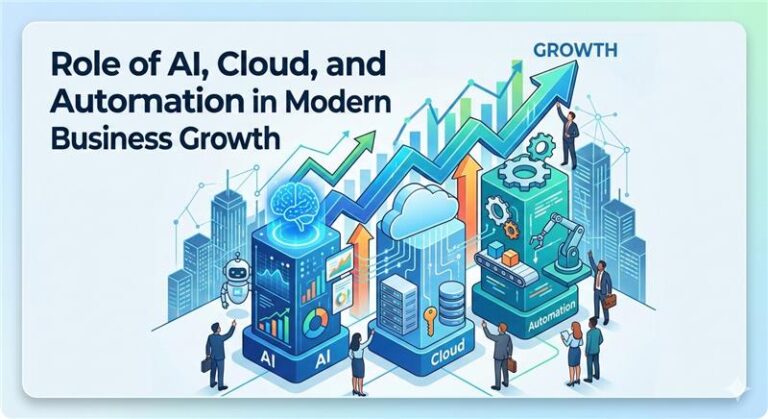
These technologies also help organizations reduce human error, improve response times, strengthen fraud prevention, and increase operational visibility. As digital transformation accelerates across industries, AI is becoming an important part of long-term business growth strategies.
How Different Industries Use AI Solutions
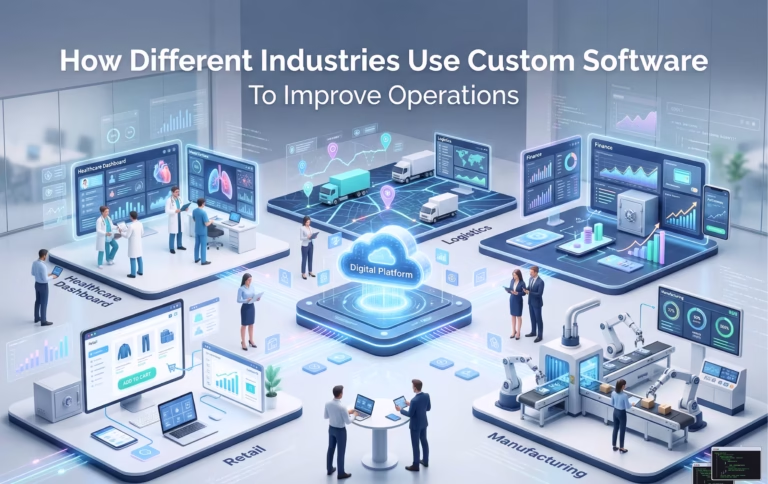
Different industries use AI and machine learning solutions in different ways depending on operational challenges, customer expectations, and business goals. From fraud prevention and predictive analytics to workflow automation and personalization, AI is helping organizations improve efficiency and scalability across multiple sectors.
| Industry | Common AI Applications |
| FinTech | Fraud detection, credit scoring, compliance automation |
| Healthcare | Patient analytics, medical document processing, AI diagnostics |
| Logistics | Route optimization, fleet intelligence, demand forecasting |
| eCommerce | Recommendation engines, personalization, dynamic pricing |
| SaaS | AI copilots, workflow automation, conversational AI |
| Manufacturing | Predictive maintenance, quality inspection, operational monitoring |
| EdTech | Personalized learning systems, student performance analysis |
Choosing the Right AI Solution
Choosing the right AI solution depends on business goals, operational complexity, available data, infrastructure readiness, and scalability requirements.
Businesses focused on improving customer engagement often invest in conversational AI and recommendation systems, while organizations managing operational complexity may prioritize predictive analytics and workflow automation.
Companies should also evaluate factors such as integration requirements, security needs, long-term scalability, and monitoring capabilities before investing in AI development.
A structured AI strategy helps businesses select technologies that align with both operational improvements and long-term digital transformation goals.
Custom AI vs Prebuilt AI Tools
Businesses often choose between custom AI development and prebuilt AI platforms depending on operational requirements, scalability goals, and budget.
Prebuilt AI tools are generally faster to implement and work well for common use cases such as chatbots, analytics, and workflow automation. However, these platforms may offer limited customization, scalability, and integration flexibility.
Custom AI solutions allow businesses to build systems aligned with internal workflows, operational requirements, infrastructure needs, and long-term business strategies.
For organizations managing complex operations and industry-specific workflows, custom AI development often provides better scalability, control, and long-term business value.
| Factor | Custom AI Solutions | Prebuilt AI Tools |
| Customization | High | Limited |
| Scalability | Flexible and business-specific | Depends on platform limitations |
| Integration | Easier integration with internal systems | Limited flexibility |
| Long-Term Control | Full ownership and customization | Vendor dependency |
| Implementation Time | Longer development cycle | Faster deployment |
Challenges Businesses Face When Building AI Solutions
Building scalable AI systems involves several technical and operational challenges. One of the biggest challenges is data quality because machine learning models rely heavily on accurate and well-structured datasets. Poor-quality data can reduce prediction accuracy and overall system reliability.
Businesses also face challenges related to infrastructure scalability, cloud deployment, enterprise integrations, API connectivity, and long-term monitoring.
In addition, AI systems require continuous optimization, retraining, and security management to maintain performance as business data and operational conditions evolve over time.
Organizations that approach AI development strategically are better positioned to reduce implementation risks and improve long-term scalability.
How Bytexus Helps Businesses Build AI Solutions
Bytexus helps businesses build scalable AI and machine learning solutions focused on automation, operational efficiency, and long-term business growth. Instead of offering generic AI tools, the company develops custom AI systems aligned with real operational workflows, infrastructure requirements, and business goals.
The company works across multiple areas of AI development, including predictive analytics, Generative AI, NLP solutions, intelligent automation, recommendation systems, AI copilots, and enterprise AI integrations.
This AI-focused approach is supported by the expertise and industry experience of author Atul Kumar Yadav, who specializes in enterprise software architecture, cloud infrastructure, and AI-driven automation systems.
With 12+ years of software development experience, 135+ global clients, and expertise across 25+ industries, Bytexus emphasizes scalable architecture, API-first development, AI monitoring, and long-term system performance.
The Future of AI and Machine Learning in Business
AI technologies are evolving rapidly as businesses move beyond basic automation toward more intelligent and adaptive systems. Technologies such as AI agents, enterprise AI copilots, predictive analytics, and intelligent workflow automation are becoming increasingly common across industries.
Businesses are also investing more in scalable AI infrastructure, cloud-native AI systems, real-time analytics, and responsible AI practices to improve long-term performance, security, and reliability.
As AI adoption continues to grow, organizations investing in scalable and business-focused AI solutions will be better positioned to improve operational efficiency, customer experience, and long-term competitiveness.
Conclusion
AI and machine learning solutions are transforming how businesses automate operations, analyze data, improve efficiency, and support intelligent decision-making.
From AI chatbots and predictive analytics to Generative AI applications and workflow automation systems, businesses now have access to a wide range of AI-powered technologies designed to solve operational challenges and improve scalability.
However, successful AI adoption requires more than implementing isolated tools. Businesses need reliable data, scalable infrastructure, strong integrations, security controls, and continuous optimization strategies to maximize long-term business value.
Organizations looking to build secure and scalable AI applications can work with experienced development partners like Bytexus to develop custom AI solutions aligned with operational goals and long-term digital transformation strategies.
Frequently Asked Questions (FAQs)
What are the most common types of AI solutions for businesses?
Common AI solutions include AI chatbots, predictive analytics systems, recommendation engines, fraud detection platforms, NLP applications, computer vision systems, Generative AI tools, and AI workflow automation platforms.
Which industries use AI and machine learning solutions?
Industries such as FinTech, Healthcare, Logistics, Manufacturing, Retail, SaaS, Insurance, and EdTech widely use AI-powered software solutions.
What is the difference between AI and machine learning?
Artificial Intelligence (AI) is the broader concept of machines performing tasks that normally require human intelligence, while Machine Learning (ML) is a subset of AI that enables systems to learn from data and improve performance over time.
Are custom AI solutions better than prebuilt AI tools?
Custom AI solutions provide greater flexibility, scalability, and integration capabilities, while prebuilt AI tools are generally faster and less expensive to implement initially.
Why is data important in AI development?
AI systems rely heavily on high-quality data to generate accurate predictions, improve automation, and maintain long-term performance.
How do businesses choose the right AI solution?
Businesses should evaluate operational goals, data availability, infrastructure readiness, scalability requirements, security needs, and integration capabilities before selecting an AI solution.