Introduction
Artificial Intelligence (AI) and Machine Learning (ML) are transforming how businesses automate operations, improve decision-making, and deliver better customer experiences. What was once limited to large technology companies is now being adopted across industries such as FinTech, Healthcare, Logistics, eCommerce, SaaS, and Manufacturing.
Businesses are increasingly investing in AI and ML software development services to solve challenges like manual workflows, rising operational costs, inaccurate forecasting, fraud risks, and inefficient business processes.
Modern AI-powered software helps companies automate repetitive tasks, analyze large volumes of data, predict customer behavior, improve operational efficiency, personalize user experiences, and optimize workflows through intelligent decision-making.
Unlike traditional software that follows fixed rules, AI systems can learn from data, improve over time, and adapt to changing business conditions.
As AI adoption continues to grow, many businesses still struggle to understand what AI and ML software development services actually include, how AI software is built, and what type of AI solutions they should invest in.
This guide explains everything businesses need to know about AI and ML software development services, including development processes, machine learning workflows, AI automation, deployment strategies, security considerations, and real-world business applications.
Key Takeaways
- AI and machine learning software development services help businesses automate operations, improve decision-making, and build intelligent applications using data-driven systems.
- Artificial Intelligence, Machine Learning, Deep Learning, and Generative AI each serve different business purposes and require different development approaches.
- Businesses across FinTech, Healthcare, Logistics, eCommerce, SaaS, Manufacturing, HRTech, and EdTech are increasingly adopting AI-powered solutions to improve efficiency and scalability.
- AI software development involves multiple stages, including business discovery, data preparation, model development, deployment, monitoring, and continuous optimization.
- High-quality data is one of the most important factors in building accurate and reliable AI systems.
- AI automation helps businesses reduce manual work, improve operational efficiency, and optimize workflows through intelligent decision-making.
- Custom AI development provides greater flexibility, scalability, and long-term business value compared to many off-the-shelf AI tools.
- AI systems require continuous monitoring, retraining, security management, and performance optimization after deployment.
- Businesses that prioritize responsible AI development, security, compliance, and scalability are better positioned for long-term AI success.
- Companies like Bytexus help businesses build scalable AI and machine learning solutions aligned with operational goals and digital transformation strategies.
What Are AI and ML Software Development Services?
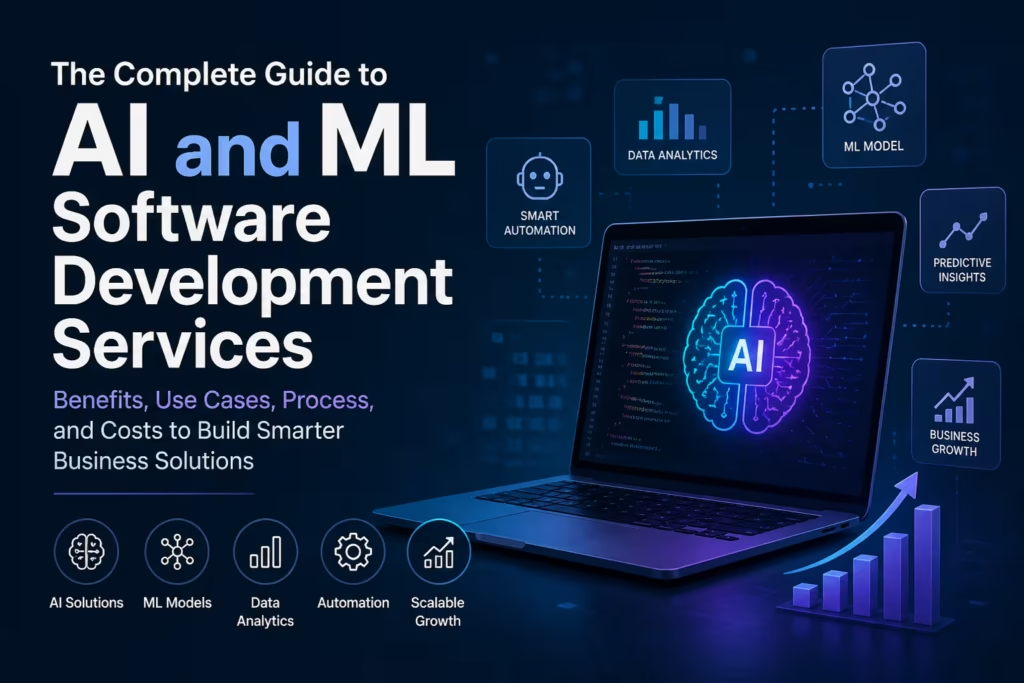
AI and ML software development services help businesses build intelligent applications that can automate tasks, analyze data, improve decision-making, and optimize operations. These services involve designing, developing, deploying, and maintaining AI-powered systems tailored to business requirements.
AI Strategy and Consulting
Businesses first identify operational challenges, AI opportunities, data availability, and long-term goals before starting development.
Machine Learning Model Development
Machine learning models are trained using historical and real-time data to generate predictions, automate decisions, and improve performance over time.
AI Application Development
AI applications may include chatbots, recommendation engines, fraud detection systems, predictive analytics platforms, and intelligent automation tools.
AI Integration and Deployment
AI solutions are integrated with existing software systems, cloud platforms, APIs, ERP systems, and enterprise workflows for seamless operations.
AI Monitoring and Optimization
AI systems require continuous monitoring, retraining, and optimization to maintain accuracy, security, and long-term performance.
Difference Between Artificial Intelligence, Machine Learning, Deep Learning, and Generative AI
Artificial Intelligence (AI), Machine Learning (ML), Deep Learning, and Generative AI are closely related technologies, but each serves a different purpose in AI software development.
Artificial Intelligence is the broader concept of machines performing tasks that normally require human intelligence. Machine Learning is a subset of AI that enables systems to learn from data and improve predictions over time. Deep Learning is a more advanced form of machine learning that uses neural networks for complex tasks like image and speech recognition. Generative AI focuses on creating new content such as text, images, code, and conversational responses.
AI vs ML vs Deep Learning vs Generative AI
| Technology | What It Does | Business Example |
| Artificial Intelligence (AI) | Simulates human intelligence and decision-making | Workflow automation, AI assistants |
| Machine Learning (ML) | Learns patterns from data | Fraud detection, forecasting |
| Deep Learning | Processes complex large-scale data | Facial recognition, speech analysis |
| Generative AI | Creates new content and responses | AI chatbots, content generation |
Understanding these technologies helps businesses choose the right AI solution based on their operational goals and use cases.
Why Businesses Are Investing in AI and ML Software Development Services
Businesses are increasingly investing in AI and ML software development services because traditional systems often struggle to handle growing operational complexity, large volumes of data, and rising customer expectations.
AI-powered software helps organizations automate repetitive tasks, improve decision-making, reduce operational costs, and increase overall efficiency. Instead of relying only on manual processes and fixed workflows, businesses can use AI systems to analyze real-time data, identify patterns, predict outcomes, and automate intelligent actions.
One of the biggest reasons behind AI adoption is automation. Companies are using AI to automate customer support, document processing, fraud detection, reporting, workflow approvals, inventory forecasting, and operational monitoring.
Businesses are also investing in machine learning solutions to improve accuracy and predictive capabilities. For example, eCommerce platforms use AI recommendation engines to personalize user experiences, while logistics companies use predictive analytics to optimize routes and demand forecasting.
AI development services also help businesses improve scalability. As operations grow, AI systems can process large amounts of information much faster than manual teams, allowing companies to scale without significantly increasing operational costs.
Types of AI and Machine Learning Solutions Businesses Can Build
Businesses across industries are using AI and machine learning solutions to automate workflows, improve customer experiences, and increase operational efficiency. The type of AI solution depends on business goals, available data, and operational requirements.
AI Chatbots and Virtual Assistants
AI chatbots help automate customer support, onboarding, lead generation, and conversational interactions.
Predictive Analytics Solutions
Businesses use predictive analytics to forecast demand, customer behavior, risks, and operational trends.
Recommendation Engines
Recommendation systems personalize products, content, and user experiences based on customer activity and preferences.
Fraud Detection Systems
Machine learning models help identify suspicious activities, anomalies, and financial fraud in real time.
NLP and Conversational AI
Natural Language Processing (NLP) solutions enable text analysis, document processing, sentiment analysis, and AI-powered communication systems.
Computer Vision Applications
Computer vision systems support facial recognition, image analysis, quality inspection, and video monitoring workflows.
Generative AI Solutions
Generative AI applications help businesses build AI assistants, intelligent copilots, content generation platforms, and conversational AI systems.
Common AI Solutions Businesses Build
| AI Solution | Primary Use Case |
| AI Chatbots | Customer support and conversational automation |
| Predictive Analytics | Forecasting trends, demand, and risks |
| Recommendation Engines | Product and content personalization |
| Fraud Detection Systems | Identifying suspicious activity |
| NLP Solutions | Text analysis and document processing |
| Computer Vision Systems | Image and video recognition |
| AI Automation Platforms | Workflow and process automation |
| Generative AI Applications | AI assistants and content generation |
The right AI solution depends on factors such as business goals, operational challenges, available data, scalability requirements, and long-term digital transformation strategies.
How AI Software Development Works
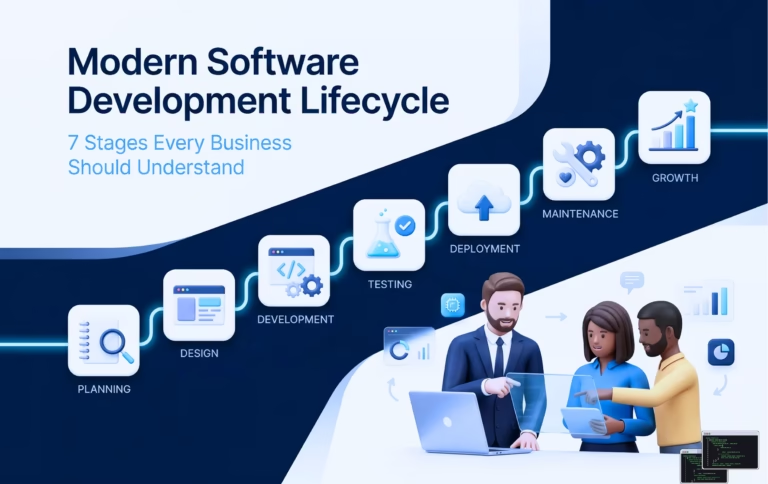
AI software development follows a structured process that helps businesses transform raw data into intelligent systems capable of automation, prediction, and decision-making.
The process usually begins with identifying business goals, operational challenges, and the specific use case the AI solution is expected to solve. Once the objectives are clear, businesses collect and prepare data because machine learning models rely heavily on high-quality datasets for accurate results.
After data preparation, developers select and train machine learning models using historical and real-time data. The trained model is then tested to evaluate its accuracy, reliability, and performance before deployment.
Once approved, the AI model is integrated into business applications, workflows, APIs, or cloud infrastructure. However, AI development does not stop after deployment. Models require continuous monitoring and retraining to maintain accuracy as business data and user behavior evolve over time.
AI Software Development Process
| Stage | What Happens |
| Business Discovery | Identify goals, challenges, and AI opportunities |
| Data Preparation | Collect, clean, and organize datasets |
| Model Development | Build machine learning models |
| AI Training | Train the model using business data |
| Testing & Validation | Measure performance and accuracy |
| Deployment | Integrate AI into live applications |
| Monitoring | Track performance and retrain models |
A structured AI development process helps businesses build scalable, reliable, and production-ready AI applications aligned with long-term operational goals.
What Data Do Businesses Need for AI Development?
Data is the foundation of every AI and machine learning project. The quality, accuracy, and structure of data directly impact how well an AI model performs.
Businesses use different types of data for AI development, including customer interactions, transaction records, operational data, documents, images, videos, sensor data, and application activity. This data is used to train machine learning models to recognize patterns, generate predictions, and automate decisions.
AI systems typically rely on two types of data: structured data and unstructured data. Structured data includes organized information such as spreadsheets, databases, and financial records, while unstructured data includes emails, PDFs, images, videos, audio files, and customer conversations.
Before training an AI model, businesses usually clean, organize, and label data to improve accuracy and reduce errors. Poor-quality data often leads to inaccurate predictions and unreliable AI performance.
AI Automation for Business Operations
AI automation helps businesses reduce manual work, improve efficiency, and automate repetitive operational processes using intelligent decision-making systems.
Unlike traditional automation that follows fixed rules, AI-powered automation can analyze data, learn patterns, and adapt to changing business conditions. This allows businesses to automate more complex workflows that normally require human involvement.
Many organizations use AI automation to streamline customer support, invoice processing, document verification, reporting, approvals, scheduling, fraud detection, inventory management, and workflow monitoring.
For example, AI-powered customer support systems can automatically respond to user queries, while machine learning models can identify unusual financial transactions in real time. Similarly, businesses use predictive AI systems to automate forecasting, operational planning, and risk analysis.
Industry Applications of AI and Machine Learning
AI and machine learning software development services are being adopted across multiple industries to improve efficiency, automate operations, strengthen decision-making, and enhance customer experiences.
Different industries use AI in different ways depending on their operational challenges, business goals, and data availability.
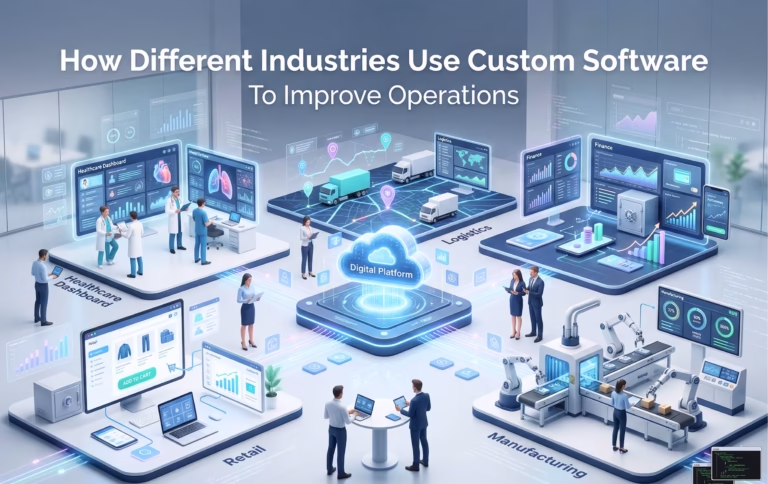
For example, FinTech companies use AI for fraud detection, risk scoring, and compliance automation, while healthcare organizations use machine learning for patient analytics, medical data processing, and clinical risk prediction.
Logistics companies rely on predictive analytics and route optimization systems to improve fleet efficiency and demand forecasting. Similarly, eCommerce businesses use recommendation engines, personalization systems, and pricing intelligence tools to increase customer engagement and conversions.
SaaS companies are increasingly integrating AI copilots, workflow automation, and conversational AI features directly into their platforms to improve user productivity and product experience.
AI Use Cases Across Industries
| Industry | Common AI Applications |
| FinTech | Fraud detection, credit scoring, compliance automation |
| Healthcare | Patient analytics, clinical AI, document processing |
| Logistics | Route optimization, fleet intelligence, forecasting |
| eCommerce | Personalization, recommendation engines, pricing optimization |
| SaaS | AI copilots, workflow automation, chatbots |
| Manufacturing | Predictive maintenance, quality inspection |
| HRTech | Resume screening, workforce analytics |
| EdTech | Personalized learning and student performance analysis |
As AI adoption continues to grow, businesses across industries are using intelligent systems to improve scalability, operational efficiency, and long-term competitiveness.
Custom AI Development vs Off-the-Shelf AI Tools
Businesses investing in AI often face an important decision: should they build a custom AI solution or use an existing AI tool?
Off-the-shelf AI tools are prebuilt platforms designed for general business use cases such as chatbots, automation, analytics, and content generation. These tools are usually faster to implement and require lower upfront investment.
Custom AI development, on the other hand, focuses on building AI systems tailored to a company’s specific workflows, operational requirements, business logic, and data environment.
Prebuilt AI tools work well for common use cases, but they may offer limited flexibility, scalability, customization, and integration capabilities. Custom AI software provides greater control, stronger personalization, better scalability, and more accurate business-specific outputs.
Custom AI vs Off-the-Shelf AI Tools
| Factor | Custom AI Development | Off-the-Shelf AI Tools |
| Customization | High | Limited |
| Scalability | Flexible and business-specific | Depends on vendor limitations |
| Integration | Easier integration with internal systems | Limited integration flexibility |
| Development Time | Longer implementation | Faster deployment |
| Upfront Cost | Higher initial investment | Lower initial cost |
| Long-Term Value | Higher business control and ownership | Subscription-based dependency |
Businesses with complex workflows, large datasets, industry-specific requirements, or long-term AI strategies often prefer custom AI development for better operational alignment and competitive advantage.
The right approach depends on business goals, budget, scalability requirements, data availability, and long-term digital transformation plans.
How Much Does AI Software Development Cost?
The cost of AI software development depends on several factors, including project complexity, data availability, infrastructure requirements, AI model type, integrations, and deployment scale.
Simple AI applications such as chatbots or workflow automation systems generally require lower investment, while advanced machine learning platforms, predictive analytics systems, and Generative AI applications involve higher development costs due to model training, infrastructure, and ongoing optimization requirements.
AI development costs also vary based on whether businesses use pre-trained models, custom machine learning models, cloud-based AI services, or enterprise-grade AI infrastructure.
Why AI Deployment and Monitoring Matter in AI Software Development
Many businesses assume AI development ends once the model is deployed, but successful AI systems require continuous monitoring, optimization, and maintenance to remain accurate and reliable over time.
After deployment, AI models start interacting with real-world business data, customer behavior, and changing operational conditions. As this data evolves, model performance can gradually decline, which is why ongoing monitoring and retraining are important parts of AI software development.
For example, a fraud detection system trained on older transaction patterns may become less effective as fraud behavior changes. Similarly, recommendation engines and predictive analytics systems need updated data to maintain accurate and relevant results.
Businesses monitor AI systems to track prediction accuracy, identify performance issues, improve security, reduce bias, and maintain operational reliability. Regular retraining also helps machine learning models adapt to new business conditions and continuously improve performance.
Strong AI monitoring strategies help businesses maintain long-term AI accuracy, improve scalability, reduce operational risks, and maximize the value of their AI investments.
Why Security and Compliance Matter in AI Software Development
AI systems often process sensitive business data such as customer information, financial records, healthcare documents, operational workflows, and internal communications. Because of this, security and compliance have become essential parts of AI software development.
Without proper security controls, AI applications may expose businesses to risks such as data breaches, unauthorized access, biased outputs, and compliance violations. This is especially important in industries like FinTech, Healthcare, Insurance, and HRTech where businesses manage regulated and confidential information.
Modern AI development focuses not only on building intelligent systems but also on protecting data throughout the entire AI lifecycle. Businesses implement secure cloud infrastructure, encrypted storage, access control systems, API protection, and continuous monitoring to maintain data security during model training, deployment, and integration.
Responsible AI development is also becoming increasingly important. Businesses now prioritize transparency, explainability, bias reduction, and ethical AI practices to ensure AI systems generate reliable and trustworthy outputs.
As AI adoption grows, companies that prioritize security, compliance, and responsible AI practices are better positioned to build scalable AI systems while maintaining customer trust and long-term operational reliability.
How Bytexus Approaches AI Software Development
Bytexus approaches AI software development with a strong focus on business goals, operational scalability, and long-term performance. Instead of treating AI as only a technology initiative, the company focuses on building practical AI solutions that solve real business challenges and integrate smoothly into existing workflows.
The development process begins with understanding operational bottlenecks, business requirements, available datasets, and long-term objectives. This helps ensure the AI solution aligns with real-world business use cases rather than unnecessary experimentation.
Bytexus works across multiple areas of AI and machine learning development, including AI automation, predictive analytics, NLP solutions, Generative AI applications, recommendation systems, intelligent workflow automation, and AI-powered enterprise platforms.
One of the key differentiators of Bytexus is its business-first AI development approach. The company focuses not only on model development but also on scalability, system integration, cloud infrastructure, data security, monitoring, and long-term optimization.
With 12+ years of software development experience, 135+ global clients, expertise across 25+ industries, and a strong focus on scalable digital transformation, Bytexus helps businesses build AI systems that improve automation, efficiency, customer experiences, and operational decision-making.
The company also emphasizes secure AI development practices, flexible architecture, continuous monitoring, and enterprise-grade implementation strategies to support long-term business growth.
Future of AI and Machine Learning Software Development
AI and machine learning technologies are evolving rapidly, and businesses are moving beyond basic automation toward more intelligent, adaptive, and data-driven systems.
One of the biggest shifts is the rise of Generative AI applications such as AI assistants, conversational AI platforms, AI copilots, and intelligent content generation systems. Businesses are increasingly integrating these capabilities into customer support, internal operations, analytics, and enterprise software products.
AI-powered automation is also becoming more advanced. Instead of automating only repetitive tasks, modern AI systems can now support decision-making, workflow optimization, predictive analysis, and real-time operational intelligence.
At the same time, businesses are focusing more on scalable AI infrastructure, responsible AI development, data security, and continuous AI monitoring to ensure long-term reliability and performance.
As AI adoption continues to grow across industries, companies that invest in intelligent automation, machine learning solutions, and AI-powered software development will be better positioned to improve efficiency, scalability, customer experience, and long-term competitive advantage.
AI is no longer just an emerging technology trend. It is becoming a core part of modern business operations and digital transformation strategies.
Conclusion
AI and machine learning are no longer limited to large technology companies or experimental projects. Businesses across industries are now using AI-powered software to automate operations, improve efficiency, strengthen decision-making, and deliver better customer experiences.
From predictive analytics and intelligent automation to Generative AI applications and machine learning models, AI software development is becoming an important part of modern digital transformation strategies.
However, successful AI adoption requires more than just implementing new technology. Businesses need the right development strategy, high-quality data, scalable infrastructure, continuous monitoring, and long-term optimization to build reliable AI systems that create measurable business value.
As AI adoption continues to accelerate, companies that invest in scalable and business-focused AI solutions will be better positioned to improve operational performance, increase competitiveness, and adapt to changing market demands.
Businesses looking to build custom AI and machine learning solutions can work with experienced development partners like Bytexus to develop secure, scalable, and business-aligned AI applications designed for long-term growth.
Frequently Asked Questions (FAQs)
What are AI and ML software development services?
AI and ML software development services involve building intelligent software systems that can analyze data, automate tasks, recognize patterns, generate predictions, and improve performance over time. These services typically include AI strategy, machine learning model development, data engineering, deployment, automation, and monitoring.
What is the difference between AI and machine learning?
Artificial Intelligence is the broader concept of machines performing tasks that normally require human intelligence, while Machine Learning is a subset of AI that enables systems to learn from data and improve predictions without being manually programmed for every scenario.
What industries use AI and machine learning solutions?
AI and machine learning solutions are widely used across industries such as FinTech, Healthcare, Logistics, eCommerce, SaaS, Manufacturing, HRTech, EdTech, Insurance, and Real Estate.
How long does AI software development take?
The timeline depends on the complexity of the project, data availability, integrations, and business requirements. Simple AI applications may take a few weeks, while enterprise-grade AI systems can require several months of development and optimization.
What data is required for AI development?
Businesses typically use structured and unstructured data such as customer records, operational data, transaction history, documents, images, videos, and application activity to train AI models.
What is the cost of AI software development?
AI development costs vary based on project complexity, AI model type, infrastructure, integrations, and deployment scale. Custom AI systems generally require higher investment than prebuilt AI tools but offer greater scalability and flexibility.
Why is AI monitoring important after deployment?
AI models require continuous monitoring and retraining because business data, customer behavior, and operational conditions change over time. Monitoring helps maintain model accuracy, performance, and reliability.
Should businesses choose custom AI development or off-the-shelf AI tools?
The right choice depends on business goals, scalability requirements, budget, and operational complexity. Off-the-shelf tools are faster to implement, while custom AI development offers greater flexibility, personalization, and long-term control.