Introduction
AI and ML software development services enable businesses to build systems that can analyze data, learn from patterns, and make intelligent decisions with minimal human involvement.
Traditional software follows fixed rules. AI-driven systems, on the other hand, adapt, improve, and evolve based on data, making them far more powerful in dynamic business environments.
Today, organizations across industries are using AI and ML to automate operations, enhance customer experiences, reduce costs, and gain actionable insights. From fraud detection in finance to personalized recommendations in eCommerce, AI is no longer experimental — it is a core part of modern business strategy.
This guide explains what AI and ML development services are, how they work, their types, real-world applications, costs, benefits, and how to choose the right development partner.
Key Takeaways
- AI and ML help businesses move from rule-based systems to intelligent, data-driven decision-making
- Machine Learning enables systems to continuously learn from data and improve performance over time
- The success of any AI solution depends heavily on the quality, availability, and structure of data
- AI development follows a clear lifecycle: data collection, model building, training, deployment, and continuous optimization
- Businesses across industries are already using AI for automation, prediction, personalization, and efficiency improvements
- AI not only reduces manual effort but also enhances customer experience and operational accuracy
- While initial investment may be higher, AI delivers strong long-term ROI through optimization and cost reduction
- AI systems are not static and require ongoing monitoring, updates, and retraining for sustained performance
- Choosing the right AI/ML development partner plays a critical role in project success and scalability
- Early adoption of AI gives businesses a competitive advantage in an increasingly data-driven market
What Are AI and ML Software Development Services?
AI and ML software development services involve creating intelligent applications that can process large amounts of data, identify patterns, and make decisions without being explicitly programmed for every scenario.
Understanding the Core Concepts
- Artificial Intelligence (AI):
A broad field focused on building systems that simulate human intelligence, such as reasoning, problem-solving, and decision-making.
- Machine Learning (ML):
A subset of AI that allows systems to learn from historical data and improve performance over time.
In practical terms, AI defines what the system should achieve, while ML determines how the system learns and improves continuously.
How AI and ML Development Works
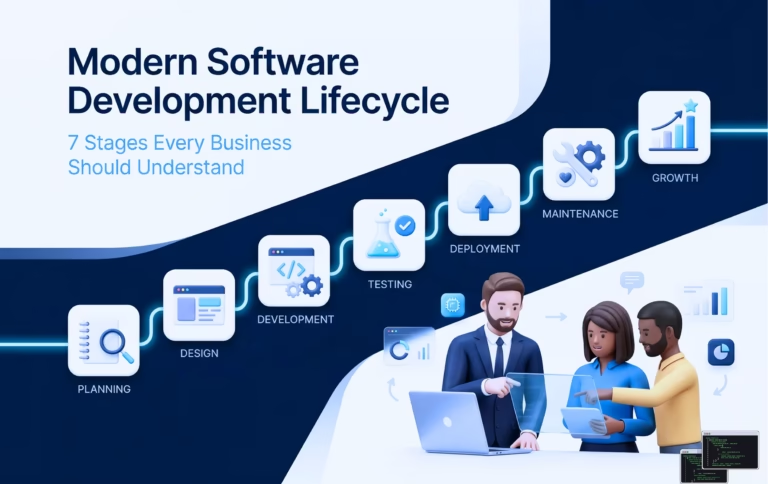
Building AI systems is not a single step process. It follows a structured lifecycle that ensures accuracy, scalability, and business alignment.
Data Collection and Preparation
AI models rely heavily on data. Businesses collect data from multiple sources such as databases, applications, APIs, and user interactions.
This data is then cleaned and prepared by:
- Removing inconsistencies and duplicates
- Handling missing values
- Structuring it into usable formats
The quality of data directly impacts model performance.
Model Development
Once the data is ready, developers design models based on the business problem.
This includes:
- Selecting the right ML approach (supervised, unsupervised, deep learning)
- Choosing algorithms like regression, classification, or clustering
- Designing the model architecture
The goal is to build a system capable of identifying meaningful patterns.
Model Training and Testing
The model is trained using historical data and tested to evaluate performance.
Key activities:
- Training on datasets
- Validating with test data
- Measuring accuracy and precision
Iteration is critical to improve reliability.
Deployment
After validation, the model is deployed into real-world environments such as web apps, mobile platforms, or enterprise systems.
This step ensures:
- Integration with existing systems
- Scalability
- Real-time usability
Monitoring and Optimization
AI models need regular evaluation and refinement to stay accurate as data and business conditions evolve.
This involves:
- Tracking performance
- Updating models with new data
- Improving accuracy over time
AI is not static — it evolves continuously.
Types of AI and ML Software Development Services
Different businesses require different AI solutions depending on their goals and data maturity.
| Service Type | What It Does | Business Value |
| Custom AI Solutions | Builds tailored AI systems | Solves specific business problems |
| ML Model Development | Creates predictive models | Improves forecasting & decisions |
| NLP Solutions | Understands human language | Powers chatbots & automation |
| Computer Vision | Interprets visual data | Used in healthcare, security |
| Predictive Analytics | Forecasts future trends | Better planning & risk control |
| Recommendation Systems | Suggests personalized content | Boosts engagement & sales |
Choosing the right service depends on your business objective, not just technology.
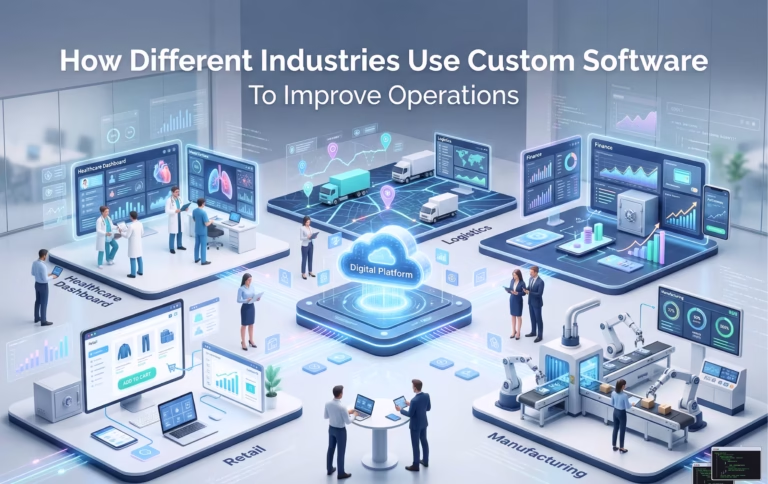
Real-World Use Cases Across Industries
AI and ML are already delivering measurable results across industries.
Finance
Used for fraud detection, credit scoring, and risk analysis. AI can detect unusual transaction patterns in real time, reducing financial losses.
Healthcare
Helps in disease prediction, medical imaging analysis, and personalized treatment planning. AI improves diagnostic accuracy and operational efficiency.
Logistics & Supply Chain
Optimizes routes, predicts demand, and manages inventory. This reduces costs and improves delivery timelines.
Retail & eCommerce
Enables personalized recommendations, customer segmentation, and dynamic pricing strategies that increase conversions.
Marketing & SaaS Platforms
Used for customer behavior analysis, campaign optimization, and intelligent automation tools that improve ROI.
These use cases highlight that AI is not theoretical — it is actively driving business performance.
Key Benefits of AI and ML Development
AI and ML adoption delivers both operational and strategic advantages.
Operational Benefits
- Automates repetitive tasks
- Reduces manual effort
- Improves efficiency
Strategic Benefits
- Enables data-driven decision-making
- Enhances customer experience through personalization
- Supports scalability and business growth
Financial Impact
- Reduces operational costs
- Improves ROI through optimization
- Minimizes risks with predictive insights
Businesses using AI gain both efficiency and competitive advantage.
AI vs ML vs Traditional Software
Understanding the difference helps businesses choose the right approach.
| Feature | Traditional Software | AI | ML |
| Logic | Fixed rules | Smart logic | Learns from data |
| Adaptability | No | Yes | Yes |
| Improvement | Manual | Limited | Continuous |
| Use Case | Static workflows | Decision systems | Predictive systems |
If your business needs adaptability and prediction, AI/ML is the right choice.
Cost of AI and ML Development
AI development costs vary based on project scope and complexity.
Key Cost Factors
- Data availability and quality
- Complexity of the model
- Level of customization
- Integration with existing systems
- Ongoing maintenance
Cost Perspective
- Basic AI solutions (chatbots, analytics): Moderate investment
- Advanced AI systems (deep learning, automation platforms): Higher investment
AI should be viewed as a long-term investment with measurable ROI, not just an expense.
Challenges in AI and ML Development
AI implementation comes with a few practical challenges.
Poor data quality can reduce accuracy, and collecting clean data often takes time. Initial investment may be higher compared to traditional software, especially for advanced models.
Integration with existing systems can also be complex, particularly for businesses using legacy tools. Additionally, AI models require ongoing monitoring and updates to stay accurate.
With proper planning and the right expertise, these challenges can be managed effectively.
How to Choose the Right AI/ML Development Partner
Choosing the right AI/ML development partner is essential for building solutions that deliver real business value, not just technical output. Start by evaluating their experience and past projects, as proven work matters more than promises. Strong technical expertise in machine learning, data engineering, and cloud technologies is equally important to ensure scalability and performance. You should also consider their industry understanding, since AI solutions need to be tailored to specific business challenges rather than built as generic models.
In addition, make sure the partner offers ongoing support and optimization, because AI systems require continuous updates to stay accurate and effective. A company like Bytexus, with over 12 years of experience and a global client base across multiple industries, focuses on building customized, scalable AI solutions aligned with business goals rather than one-size-fits-all implementations.
The right partner does not just develop AI systems — they help you achieve long-term growth and competitive advantage.
Future of AI and ML in Business
AI and ML are becoming essential for modern businesses, enabling faster decision-making, improved efficiency, and smarter automation. Technologies like generative AI are reshaping how companies create content, analyze data, and build products, while automation is reducing manual effort across operations.
At the same time, advancements in real-time processing and cloud-based AI are making these solutions more accessible and scalable for businesses of all sizes. As adoption continues to grow, companies that implement AI strategically will be better positioned to innovate, scale, and stay competitive in a data-driven market.
How to Get Started with AI and ML in Your Business
Implementing AI and ML does not require a massive transformation from day one. The key is to start strategically and scale gradually.
Define a Clear Business Problem
Start by identifying where AI can create the most impact, such as reducing manual work, improving predictions, or enhancing customer experience. Avoid adopting AI just for the sake of technology.
Evaluate Your Data Readiness
AI models depend on data. Assess whether you have enough structured and relevant data. If not, begin with data collection and organization before moving to development.
Start with a Focused MVP (Minimum Viable Product)
Instead of building a full-scale AI system, begin with a smaller use case like a chatbot, recommendation engine, or predictive model. This reduces risk and helps validate results quickly.
Choose the Right Technology Stack
Select tools, frameworks, and cloud platforms that align with your scalability and performance needs. This ensures your AI solution can grow with your business.
Partner with an Experienced AI Development Company
Working with the right experts helps you avoid common mistakes and accelerates implementation. An experienced partner can guide you from strategy to deployment and ongoing optimization.
Conclusion
AI and ML software development services are helping businesses move beyond traditional systems by enabling automation, smarter decision-making, and scalable growth. As data becomes more important, companies that use AI effectively can improve efficiency, reduce costs, and deliver better customer experiences.
The key to success lies in combining the right strategy, quality data, and a reliable development partner. Businesses that adopt AI early and implement it thoughtfully will be better positioned to grow and stay competitive in the long run.
Ready to Build AI-Powered Solutions for Your Business?
AI and ML are no longer optional for businesses that want to stay competitive. The real advantage comes from implementing the right solution with the right strategy.
If you’re planning to adopt AI, working with an experienced partner like Bytexus can help you build scalable, secure, and business-focused AI solutions. With deep expertise across industries and a strong focus on custom development, they help businesses turn complex data into real outcomes.
Whether you want to automate processes, improve decision-making, or build intelligent applications, the right guidance can make all the difference.
FAQs:
What do AI and ML development services actually include?
AI and ML development services focus on designing systems that can interpret data, identify patterns, and support decision-making. This usually includes data preparation, model creation, deployment into real applications, and ongoing improvement of the system as new data comes in.
Are AI and ML the same thing or different?
They are closely related but not identical. AI is the broader concept of creating intelligent systems, while ML is a method within AI that enables systems to learn from data instead of relying only on predefined rules.
How much time is needed to build an AI-based solution?
Timelines vary depending on the problem and data readiness. A small proof-of-concept might take a few weeks, while a production-level system with integrations and optimization can take several months.
Is AI development only suitable for large enterprises?
Not anymore. With cloud-based tools and modular solutions, even small and mid-sized businesses can start with targeted AI use cases and expand gradually based on results.
What factors influence the cost of AI and ML development?
Costs depend on how complex the solution is, how much data is available, how clean that data is, and whether the system needs to integrate with existing platforms. Ongoing improvements and monitoring also contribute to long-term costs.
Do AI models work perfectly after deployment?
No. AI systems need continuous evaluation and refinement because data changes over time. Without updates, model accuracy can decline and impact results.
Which industries benefit the most from AI and ML?
Industries like finance, healthcare, logistics, retail, and SaaS see strong benefits because they deal with large volumes of data and require prediction, automation, or personalization.