Introduction
Generative AI is transforming how businesses automate operations, improve productivity, and deliver customer experiences. Companies across industries such as FinTech, Healthcare, Logistics, SaaS, Manufacturing, and eCommerce are increasingly investing in Generative AI development for business to build smarter and more scalable digital systems.
Unlike traditional automation tools that follow fixed rules, Generative AI systems can understand context, generate content, analyze data, automate workflows, and support intelligent decision-making. Businesses are now using Generative AI solutions to build AI chatbots, enterprise copilots, document processing systems, AI-powered search platforms, workflow automation tools, and customer support applications.
As enterprise AI adoption continues to grow, businesses are increasingly looking for scalable AI solutions that improve automation, customer experience, operational efficiency, and enterprise productivity.
This guide explains everything businesses need to know about Generative AI development, including business use cases, development workflows, costs, deployment strategies, security considerations, and long-term implementation planning.
Key Takeaways
- Generative AI development for business helps organizations automate workflows, improve productivity, and build intelligent AI-powered applications.
- Businesses can develop AI chatbots, enterprise copilots, AI search systems, workflow automation platforms, and content generation tools using Generative AI technologies.
- Modern Generative AI solutions use Large Language Models (LLMs), cloud infrastructure, APIs, vector databases, and enterprise integrations to support real-world business operations.
- Industries such as FinTech, Healthcare, Logistics, SaaS, Retail, and Manufacturing are increasingly adopting Generative AI solutions to improve operational efficiency and customer experience.
- Custom Generative AI development offers greater scalability, flexibility, and long-term control compared to many prebuilt AI tools.
- Organizations adopting Generative AI must focus on strong security controls, regulatory compliance, continuous monitoring, and ethical AI practices to ensure system reliability and safeguard sensitive business information.
- Companies like Bytexus help businesses build scalable and secure Generative AI solutions aligned with operational goals and long-term digital transformation strategies.
What Is Generative AI Development for Business?
Generative AI development for business involves building intelligent AI-powered systems that can generate content, automate workflows, analyze business data, and improve operational efficiency using technologies such as Large Language Models (LLMs), Natural Language Processing (NLP), and scalable AI-driven business systems.
Unlike traditional automation systems that follow fixed rules, Generative AI applications can understand context, generate human-like responses, and support more dynamic business operations. Businesses across industries are increasingly adopting Generative AI solutions to improve productivity, reduce manual workloads, and enhance customer experiences.
How Generative AI Works
Generative AI systems are trained on large datasets that help AI models understand language, workflows, patterns, and business interactions. These systems use AI models, cloud infrastructure, APIs, and enterprise integrations to process information and generate intelligent outputs in real time.
Common Generative AI Business Applications
Businesses use Generative AI development to build AI chatbots, enterprise copilots, AI-powered search systems, document intelligence platforms, customer support automation tools, and workflow automation solutions. Many enterprises also integrate Generative AI into CRMs, ERPs, analytics platforms, and cloud applications to improve scalability and productivity.
Generative AI vs Traditional AI Systems
Businesses often compare Generative AI with traditional AI systems when planning AI adoption strategies. While both technologies use artificial intelligence, they solve different business problems and support different operational goals.
Traditional AI systems are mainly designed to analyze data, identify patterns, automate repetitive tasks, and improve predictions. Generative AI systems focus on generating new outputs such as text, summaries, reports, conversations, code, and intelligent responses.
Traditional AI Systems
Traditional AI works best for structured workflows and prediction-based operations. Businesses commonly use these systems for forecasting, fraud prevention, recommendation engines, and operational analytics.
Generative AI Systems
Generative AI systems are designed to generate content, automate communication, summarize information, and support conversational workflows. These systems are increasingly used for AI copilots, virtual assistants, AI-powered search, workflow automation, and customer support applications.
| Factor | Traditional AI | Generative AI |
| Primary Purpose | Prediction and analysis | Content and response generation |
| Data Usage | Mostly structured data | Structured and unstructured data |
| Common Use Cases | Forecasting, fraud detection | AI assistants, copilots, automation |
| Interaction Style | Predictive or rule-based | Conversational and contextual |
| Flexibility | Limited to trained tasks | More adaptive and dynamic |
Why Businesses Are Investing in Generative AI
Businesses are increasingly investing in Generative AI development to automate operations, improve productivity, and handle growing operational complexity more efficiently.
Organizations use Generative AI to automate customer support, document processing, reporting, workflow management, and internal communication. AI-powered chatbots, enterprise copilots, and workflow automation systems help businesses reduce manual workloads and improve efficiency.
Generative AI enhances customer experience by delivering faster support, personalized interactions, and intelligent automation while helping businesses scale operations more efficiently.
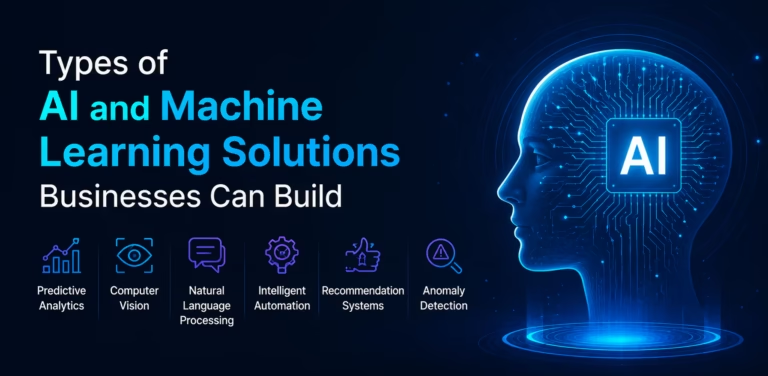
Types of Generative AI Solutions Businesses Can Build
Businesses can build different types of Generative AI solutions depending on operational goals, customer requirements, and workflow challenges.
AI Chatbots and Virtual Assistants
Businesses use AI chatbots and virtual assistants to automate customer support, onboarding, appointment scheduling, lead qualification, and internal communication workflows.
Enterprise AI Copilots
Enterprise AI copilots help employees improve productivity through reporting assistance, document summarization, internal search, workflow automation, and business communication support.
AI-Powered Search and Knowledge Systems
Generative AI search systems help businesses retrieve information from internal documents, databases, and knowledge bases more efficiently while improving internal knowledge management.
AI Workflow Automation Systems
Businesses use Generative AI to automate repetitive operational tasks such as invoice processing, compliance verification, approvals, and workflow management.
AI Content Generation Platforms
Generative AI content systems help businesses create marketing content, reports, product descriptions, summaries, and business documentation faster.
AI Document Processing Solutions
AI-powered document intelligence systems help businesses analyze, summarize, classify, and process large volumes of structured and unstructured documents.
AI Analytics and Reporting Systems
Generative AI analytics platforms help organizations generate business insights, automate reporting, and support decision-making using real-time operational data.
Industries Using Generative AI Solutions
Generative AI is being adopted across multiple industries to automate operations, improve decision-making, and enhance customer experiences.
| Industry | Common Generative AI Use Cases |
| FinTech | Fraud analysis, AI support assistants, compliance automation |
| Healthcare | Medical documentation, patient support, clinical data analysis |
| Logistics | Shipment tracking assistants, workflow automation, route insights |
| eCommerce | Product recommendations, AI customer support, content generation |
| SaaS | AI copilots, workflow automation, AI-powered search |
| Manufacturing | Operational reporting, predictive maintenance insights |
| HRTech | Resume screening, employee support systems |
| EdTech | Personalized learning, AI tutoring |
| Real Estate | AI property assistants, document automation |
| Insurance | Claims processing, policy document analysis |
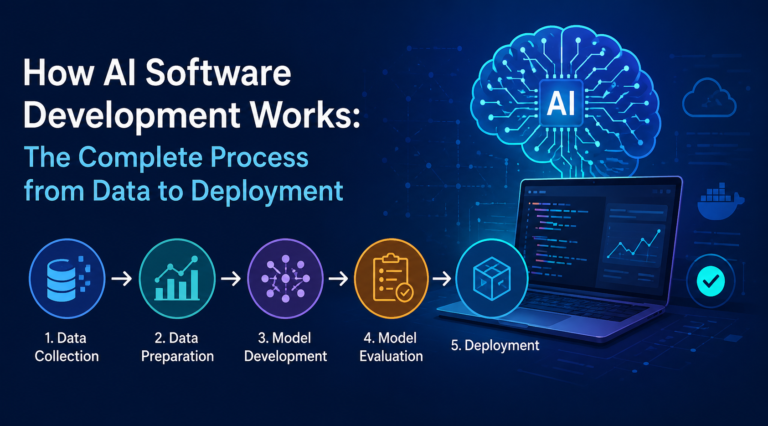
How Generative AI Development Works
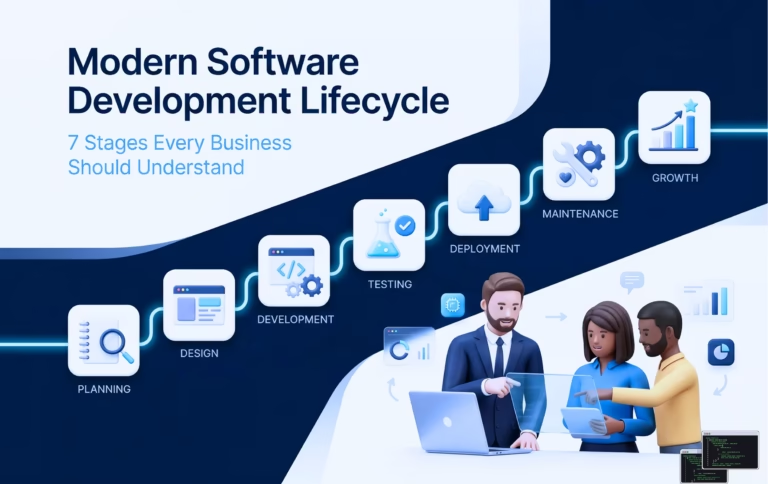
Generative AI development follows a structured process that helps businesses build scalable and production-ready AI systems.
Business Discovery and Planning
Businesses identify operational challenges, workflow gaps, use cases, scalability requirements, and integration needs before starting AI implementation.
Data Collection and Preparation
Organizations collect structured and unstructured data from applications, databases, APIs, customer interactions, and enterprise systems.
AI Model Selection
Developers select suitable AI models based on business requirements, security needs, complexity, and deployment goals.
Prompt Engineering and Workflow Design
Prompt engineering helps AI systems generate more accurate and context-aware responses while improving workflow efficiency.
AI Integration and Development
The AI system is integrated with enterprise applications, CRMs, ERPs, cloud infrastructure, and APIs to support real-world operations.
Testing and Validation
Businesses test AI systems for response quality, scalability, reliability, operational accuracy, and security before deployment.
Deployment and Monitoring
Once deployed, organizations continuously monitor AI performance, optimize workflows, improve security, and update models to maintain long-term reliability.
Generative AI Architecture Components
Modern Generative AI systems rely on multiple technologies working together to support automation, enterprise integrations, and scalable business operations.
Large Language Models (LLMs)
Large Language Models are the core engines behind Generative AI applications. These models process natural language, understand context, and generate intelligent responses.
Vector Databases
Vector databases help AI systems store and retrieve contextual information more efficiently and are commonly used in AI search systems and RAG workflows.
APIs and Enterprise Integrations
Generative AI applications connect with CRMs, ERPs, databases, cloud platforms, and third-party applications using APIs and integration layers.
Cloud Infrastructure
Cloud infrastructure provides the computing power, scalability, storage, and deployment environment required for enterprise AI systems. Businesses commonly use Amazon Web Services, Microsoft Azure, and Google Cloud for AI deployment.
AI Orchestration and Workflow Layers
AI orchestration systems manage how AI models interact with workflows, APIs, business logic, and enterprise applications.
Security and Monitoring Systems
Enterprise Generative AI solutions require monitoring, encryption, access controls, logging, and compliance management to protect sensitive business data.
Custom Generative AI Development vs Prebuilt AI Tools
Businesses investing in Generative AI often choose between custom AI development and prebuilt AI tools depending on operational complexity and long-term business goals.
Prebuilt AI platforms are generally faster to implement and suitable for basic use cases such as AI chatbots and content generation. However, they may offer limited customization and integration flexibility.
Custom Generative AI development allows businesses to build AI systems tailored to internal workflows, enterprise infrastructure, operational requirements, and security standards.
| Factor | Custom Generative AI Development | Prebuilt AI Tools |
| Customization | High | Limited |
| Scalability | Flexible and business-specific | Depends on platform limitations |
| Integration | Easier integration with internal systems | Limited flexibility |
| Security Control | Greater enterprise control | Vendor-dependent |
| Deployment Flexibility | Cloud, on-premise, or hybrid | Mostly platform-controlled |
| Long-Term Ownership | Full control | Subscription dependency |
| Implementation Time | Longer development cycle | Faster deployment |
How Much Does Generative AI Development Cost?
The cost of Generative AI development depends on project complexity, infrastructure requirements, AI model usage, integrations, deployment scale, and security needs.
Simple AI applications such as chatbots generally require lower investment, while enterprise AI copilots and large-scale automation systems involve higher development and infrastructure costs.
| Project Type | Typical Business Investment Range |
| AI Chatbots and Virtual Assistants | Low to Medium |
| AI Workflow Automation Systems | Medium |
| Enterprise AI Copilots | Medium to High |
| AI Knowledge Base Platforms | Medium to High |
| Large-Scale Generative AI Platforms | High |
Several factors influence Generative AI development costs, including:
- AI model complexity
- Data preparation
- API integrations
- Infrastructure and cloud usage
- Security and compliance requirements
- Monitoring and optimization needs
Challenges Businesses Face with Generative AI
Although Generative AI offers major business benefits, organizations often face technical, operational, and security challenges during implementation.
Data Privacy and Security Risks
Generative AI systems frequently process sensitive business information, customer records, and internal operational data, making security and compliance essential.
Inaccurate or Hallucinated Responses
AI models can sometimes generate incorrect or misleading outputs, requiring monitoring systems and validation workflows.
Integration Complexity
Many businesses struggle to integrate Generative AI systems with CRMs, ERPs, APIs, and existing enterprise infrastructure.
Infrastructure and Scalability Costs
Enterprise AI systems often require significant cloud infrastructure, computing resources, vector databases, and monitoring systems.
Monitoring and Continuous Optimization
Generative AI systems require continuous monitoring, prompt optimization, workflow improvements, and model updates to maintain accuracy and performance.
Security and Compliance in Generative AI Development
Security and compliance are critical in Generative AI development because AI systems often process sensitive customer information, operational records, and enterprise data.
Modern Generative AI systems typically include encrypted data storage, access controls, API security, monitoring systems, and secure cloud infrastructure to protect business operations.
Businesses also focus on compliance standards such as GDPR, HIPAA, and SOC 2 while prioritizing responsible AI practices, transparency, monitoring, and secure governance frameworks.
How Bytexus Approaches Generative AI Development
Bytexus approaches Generative AI development with a strong focus on business goals, scalability, and long-term performance.
The company develops custom Generative AI solutions including AI chatbots, enterprise copilots, workflow automation systems, AI-powered search platforms, and document intelligence solutions aligned with real-world business operations.
With 13+ years of software development experience, 135+ global clients, and expertise across 25+ industries, Bytexus helps businesses build scalable and secure Generative AI solutions designed for long-term growth and digital transformation.
Future of Generative AI in Business
Generative AI is rapidly evolving from basic automation tools to intelligent and adaptive business systems. Technologies such as AI agents, multimodal AI, enterprise AI copilots, and autonomous workflow automation are transforming modern business operations.
Businesses are increasingly investing in AI-powered search systems, intelligent automation, private AI infrastructure, and real-time analytics to improve operational efficiency and scalability.
As enterprise AI adoption grows, Generative AI is expected to become a core part of digital transformation and enterprise software ecosystems across industries.
How Businesses Can Start with Generative AI
Businesses planning to adopt Generative AI should begin by identifying operational challenges, repetitive workflows, and areas where automation can improve efficiency and productivity.
Organizations should evaluate available data, infrastructure readiness, integration requirements, security needs, and long-term scalability goals before starting implementation.
Many businesses begin with smaller AI projects such as AI chatbots, workflow automation systems, enterprise search tools, or document automation platforms before expanding into advanced enterprise AI systems.
Working with experienced Generative AI development companies can help businesses build scalable and secure AI solutions aligned with operational goals and long-term growth strategies.
Conclusion
Generative AI is transforming how businesses automate workflows, improve productivity, analyze information, and enhance customer experiences. From AI chatbots and enterprise copilots to workflow automation and AI-powered search systems, businesses across industries are increasingly adopting Generative AI solutions to improve operational efficiency and scalability.
However, successful Generative AI adoption requires scalable infrastructure, secure deployments, enterprise integrations, monitoring systems, and long-term optimization strategies to build reliable AI-powered applications.
Businesses looking to build scalable and secure Generative AI solutions can work with experienced development companies like Bytexus to develop custom AI applications aligned with operational goals and long-term digital transformation strategies.
What is Generative AI development for business?
Generative AI development for business involves building AI-powered applications that can generate content, automate workflows, process information, and support business operations using technologies such as Large Language Models (LLMs) and Natural Language Processing (NLP).
What can businesses build using Generative AI?
Businesses can build AI chatbots, enterprise copilots, AI-powered search systems, workflow automation platforms, document intelligence solutions, customer support systems, and AI content generation applications.
How much does Generative AI development cost?
The cost depends on project complexity, infrastructure requirements, integrations, deployment scale, AI model usage, and security needs.
Which industries use Generative AI solutions?
Industries such as FinTech, Healthcare, Logistics, SaaS, Retail, Manufacturing, HRTech, Insurance, and EdTech widely use Generative AI solutions.
What is the difference between AI and Generative AI?
Artificial Intelligence (AI) is the broader concept of machines performing intelligent tasks, while Generative AI focuses on generating content, responses, summaries, and conversational outputs.
Are custom Generative AI solutions better than prebuilt AI tools?
Custom Generative AI solutions provide greater scalability, flexibility, integration control, and long-term business alignment compared to many prebuilt AI tools.
Is Generative AI secure for enterprise use?
Yes, enterprise Generative AI systems can be secure when businesses implement proper encryption, monitoring systems, secure cloud infrastructure, and compliance practices such as GDPR, HIPAA, and SOC 2.
How long does Generative AI development take?
The timeline depends on project complexity, integrations, infrastructure requirements, deployment scale, and business requirements.
What technologies are used in Generative AI development?
Generative AI development commonly uses technologies such as Large Language Models (LLMs), Natural Language Processing (NLP), vector databases, cloud infrastructure, APIs, AI orchestration frameworks, and enterprise integrations.