Introduction
Businesses generate massive amounts of data every day, but data alone does not create value. The real advantage comes from turning that information into actionable insights that improve decision-making, efficiency, and customer experiences.
Machine learning model development helps organizations build intelligent systems that identify patterns, predict outcomes, and automate complex processes. From fraud detection and demand forecasting to personalized recommendations and predictive maintenance, machine learning is transforming how businesses operate and compete.
According to Fortune Business Insights, the global machine learning market is projected to grow from $36.73 billion in 2022 to $225.91 billion by 2030, highlighting the growing adoption of intelligent technologies across industries.
As organizations continue investing in artificial intelligence and data-driven strategies, machine learning has become a critical technology for improving efficiency, reducing costs, and creating competitive advantages. Businesses that successfully leverage machine learning can uncover insights faster, automate complex tasks, and make smarter decisions at scale.
Key Takeaways
- Machine learning model development helps businesses transform raw data into intelligent systems that support smarter decision-making.
- A successful machine learning project requires quality data, clear business objectives, and continuous model optimization.
- The development process includes data collection, preparation, feature engineering, training, testing, deployment, and monitoring.
- Businesses use machine learning for forecasting, automation, fraud detection, personalization, predictive maintenance, and operational optimization.
- Partnering with an experienced machine learning development company can accelerate implementation, reduce risk, and improve project outcomes.
What Is Machine Learning Model Development?
Machine learning model development is the process of creating AI systems that learn from data to generate predictions, recommendations, and automated decisions.
Machine learning model development is the process of building systems that learn from data to make predictions, recommendations, or decisions. These models continuously improve as they process new information, helping businesses generate more accurate insights and support data-driven decision-making.
Explore Our Guide: What Are AI and ML Software Development Services? A Complete Business Guide
Why Businesses Need Machine Learning Models
Organizations generate more data than ever before. Traditional analysis methods often struggle to uncover hidden patterns or predict future outcomes. Machine learning helps businesses process large datasets efficiently and transform information into actionable intelligence.
Traditional Analytics vs Machine Learning
Many organizations use analytics tools to understand past performance. Machine learning goes further by identifying patterns, predicting outcomes, and continuously improving as new data becomes available.
| Traditional Analytics | Machine Learning |
| Focuses on historical data | Focuses on future predictions |
| Answers “What happened?” | Answers “What will happen next?” |
| Uses predefined rules | Learns from data automatically |
| Requires manual analysis | Automates large-scale analysis |
| Generates reports | Generates predictions and recommendations |
| Remains relatively static | Improves over time |
The Complete Machine Learning Model Development Process
Building a successful machine learning solution requires a structured development process that ensures accuracy, scalability, and long-term business value.
Defining the Business Problem
Every project should begin with a clearly defined business objective. Identifying the problem first helps ensure the model delivers measurable outcomes and aligns with organizational goals.
Data Collection
Machine learning models rely on data gathered from applications, databases, business systems, websites, IoT devices, and customer interactions. Relevant data improves model accuracy and reliability.
Data Preparation and Cleaning
Raw data often contains inconsistencies, duplicates, and missing values. Cleaning and preparing datasets improves data quality and creates a stronger foundation for model training.
Feature Engineering
Feature engineering involves selecting or creating variables that improve model performance. Well-designed features help algorithms identify patterns and generate more accurate predictions.
Selecting the Right Algorithm
Different business problems require different algorithms. Choosing the right approach depends on data type, business objectives, performance requirements, and model complexity.
Model Training
During training, algorithms analyze historical data to learn patterns and relationships. This process enables the model to make predictions based on new information.
Model Testing and Validation
Testing evaluates model performance using unseen data. Validation helps identify issues such as overfitting and ensures the model performs reliably in real-world scenarios.
Model Deployment
Deployment integrates the machine learning model into business applications, workflows, or cloud environments so users can access predictions and insights.
Continuous Monitoring and Improvement
Machine learning models require ongoing monitoring and retraining. Regular updates help maintain accuracy as customer behavior, market conditions, and business processes evolve.
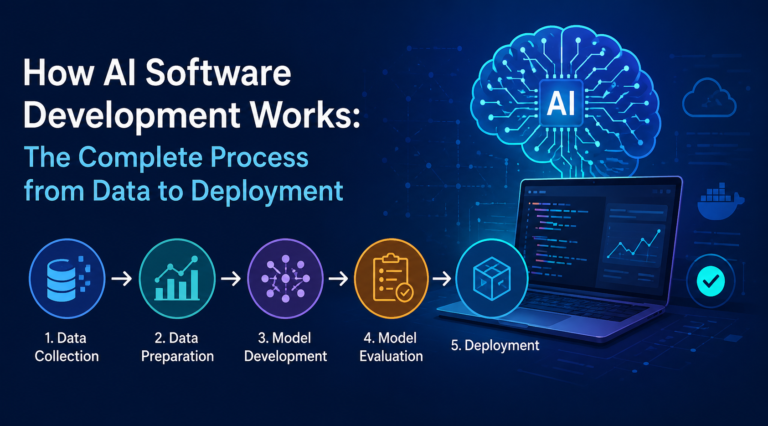
Learn More: How AI Software Development Works: The Complete Process from Data to Deployment
Types of Machine Learning Models Businesses Use
Different machine learning approaches are designed to solve different business challenges.
Supervised Learning
Supervised learning uses labeled data to predict outcomes. Common applications include fraud detection, customer churn prediction, credit scoring, and sales forecasting.
Unsupervised Learning
Unsupervised learning identifies hidden patterns in unlabeled data. Businesses commonly use it for customer segmentation, anomaly detection, and behavioral analysis.
Semi-Supervised Learning
Semi-supervised learning combines small labeled datasets with larger unlabeled datasets to improve accuracy while reducing preparation effort.
Reinforcement Learning
Reinforcement learning learns through rewards and penalties. It is often used for route optimization, robotics, resource allocation, and dynamic pricing.
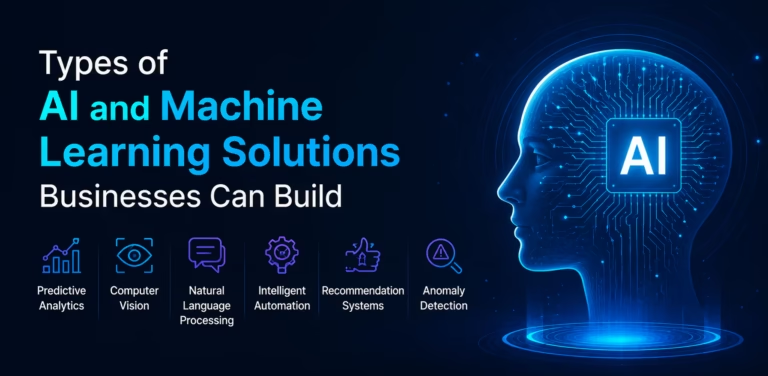
Further Reading: Types of AI and Machine Learning Solutions Businesses Can Build
Real-World Applications of Machine Learning Models
Machine learning supports a wide range of business use cases across industries.
Customer Behavior Prediction
Organizations use machine learning to understand customer preferences, predict future purchases, and improve retention through personalized engagement.
Fraud Detection and Risk Assessment
Machine learning helps identify suspicious transactions and assess risk in real time, enabling faster and more accurate fraud prevention.
Recommendation Systems
Streaming services, retailers, and digital platforms use recommendation engines to deliver personalized products, content, and experiences.
Predictive Maintenance
Manufacturers use machine learning to predict equipment failures before they occur, reducing downtime and maintenance costs.
Demand Forecasting
Businesses analyze historical sales patterns and market trends to forecast future demand and optimize inventory management.
Intelligent Automation
Machine learning helps organizations streamline workflows, reduce manual effort, and improve operational performance by enabling systems to make data-driven decisions automatically.
Also Explore: NLP Software Development: How Natural Language Processing Is Transforming Business Operations
Key Benefits of Machine Learning Model Development
Machine learning helps organizations unlock greater value from their data while improving operational efficiency, decision-making, and customer experiences.
Better Decision-Making
Machine learning provides predictive insights that help organizations make informed decisions based on data rather than assumptions or historical reporting alone.
Increased Operational Efficiency
Automation reduces manual effort, accelerates workflows, and enables teams to focus on higher-value business activities.
Enhanced Customer Experiences
Businesses can deliver personalized recommendations, targeted marketing campaigns, and tailored services based on customer behavior and preferences.
Improved Forecasting Accuracy
Machine learning identifies patterns traditional methods often miss, helping organizations forecast demand, sales, and operational requirements more accurately.
Scalable Business Growth
As data volumes increase, machine learning systems can process information efficiently without requiring significant increases in manual resources.
Common Challenges and Mistakes in Machine Learning Projects
While machine learning offers significant benefits, organizations often encounter challenges that impact project success and model performance.
Poor Data Quality
Incomplete, inconsistent, or inaccurate data can reduce model accuracy and limit the effectiveness of machine learning initiatives.
Starting Without Clear Objectives
Machine learning initiatives without clear objectives often face difficulties in delivering measurable results and supporting broader business priorities.
Limited Training Data
Insufficient data makes it difficult for models to learn reliable patterns, resulting in weaker predictions and reduced performance.
Ignoring Model Monitoring
Machine learning models require continuous monitoring and retraining. Without maintenance, performance can decline as business conditions change.
Integration Challenges
Integrating machine learning models with existing systems, workflows, and applications can create technical and operational complexities.
Best Practices for Successful Machine Learning Projects
Successful machine learning initiatives require a combination of quality data, business alignment, and ongoing optimization.
Define Clear Business Goals
Start with a specific business problem and measurable objectives to ensure the project delivers meaningful results.
Prioritize Data Quality
Clean, accurate, and well-structured data improves model performance and reduces development challenges.
Focus on Continuous Improvement
Regular monitoring, testing, and retraining help maintain accuracy and adapt to changing business conditions.
Involve Business Stakeholders
Collaboration between technical teams and business leaders ensures machine learning solutions align with operational requirements.
Plan for Scalability
Design infrastructure and workflows that can support growing data volumes and evolving business needs.
Why Businesses Partner with Machine Learning Development Companies
Many organizations choose experienced development partners to accelerate implementation and reduce project risk.
Access to Specialized Expertise
Experienced teams understand algorithms, data engineering, deployment strategies, and industry-specific machine learning challenges.
Faster Time to Market
Development partners help businesses move from concept to deployment more efficiently by following proven implementation processes.
Reduced Development Risk
Expert guidance helps organizations avoid common mistakes related to data quality, architecture, scalability, and model performance.
Scalable AI Solutions
Professional development teams build machine learning systems that can evolve alongside changing business requirements.
How Much Does Machine Learning Model Development Cost?
The cost of machine learning development varies based on project scope, data complexity, infrastructure requirements, and integration needs. Organizations should evaluate projects based on long-term business value rather than initial implementation costs alone.
Project Complexity
Projects involving advanced AI capabilities, real-time processing, or large-scale data environments typically require greater development effort and investment.
Data Preparation Requirements
Collecting, cleaning, organizing, and validating datasets often represents a significant portion of machine learning project costs.
Infrastructure and Cloud Resources
Computing power, storage requirements, and cloud services directly impact both implementation and ongoing operational expenses.
Integration Requirements
Connecting machine learning models with existing applications, databases, and workflows may require additional development and testing.
Ongoing Maintenance
Regular monitoring, retraining, optimization, and performance improvements are essential for maintaining long-term model accuracy.
Future Trends in Machine Learning Model Development
Machine learning continues to evolve as organizations seek smarter and more accessible AI solutions.
Automated Machine Learning (AutoML)
AutoML simplifies model development by automating tasks such as feature selection, training, and optimization.
Explainable AI (XAI)
Organizations increasingly demand transparent models that provide clear explanations for predictions and recommendations.
Generative AI Integration
Businesses are combining machine learning with generative AI to create more intelligent and interactive applications.
Real-Time Predictive Analytics
Organizations are investing in systems capable of delivering immediate insights and recommendations from live data streams.
Edge AI
Machine learning models are increasingly being deployed closer to where data is generated, reducing latency and improving responsiveness.
Why Choose Bytexus for Machine Learning Model Development?
Building successful machine learning solutions requires more than selecting the right algorithm. Organizations need a technology partner that can combine AI expertise, scalable architecture, and business-focused implementation to deliver measurable results.
With 13+ years of software development experience, 135+ global clients, and expertise across 25+ industries, Bytexus helps businesses develop machine learning solutions that solve real-world challenges. Our team designs and deploys custom AI models for predictive analytics, intelligent automation, recommendation systems, forecasting, and operational optimization.
From data preparation and model development to deployment, integration, and continuous improvement, Bytexus delivers scalable machine learning solutions that help organizations unlock greater value from their data and accelerate digital transformation.
Conclusion
Machine learning model development enables businesses to transform raw data into intelligent systems that improve decision-making, automate operations, and drive growth. By following a structured development process and focusing on data quality, scalability, and continuous improvement, organizations can unlock the full value of machine learning.
As businesses continue to generate more data and pursue digital transformation initiatives, machine learning will play an increasingly important role in delivering competitive advantages, operational efficiency, and innovation.
Ready to Build Intelligent Machine Learning Solutions?
Transform your data into actionable insights with custom machine learning solutions designed for growth, automation, and smarter decision-making.
CTA Button: Get a Free Consultation