Every day, businesses generate large amounts of text-based data through emails, customer conversations, contracts, invoices, reports, and support tickets. While this information contains valuable insights, manually processing it is often time-consuming and inefficient.
This is where NLP software development is making a significant impact. Natural Language Processing (NLP) enables software to understand, analyze, and process human language, helping businesses automate repetitive tasks, improve decision-making, and uncover insights hidden within unstructured data.
Today, NLP software development for business is being used to automate customer support, streamline document processing, monitor compliance, analyze customer sentiment, and improve knowledge management. As organizations continue to embrace digital transformation, NLP is becoming a critical technology for improving operational efficiency and gaining a competitive advantage.
In this guide, we’ll explore how NLP software development works, how businesses are using it across industries, its key benefits, implementation challenges, and future trends shaping the technology.
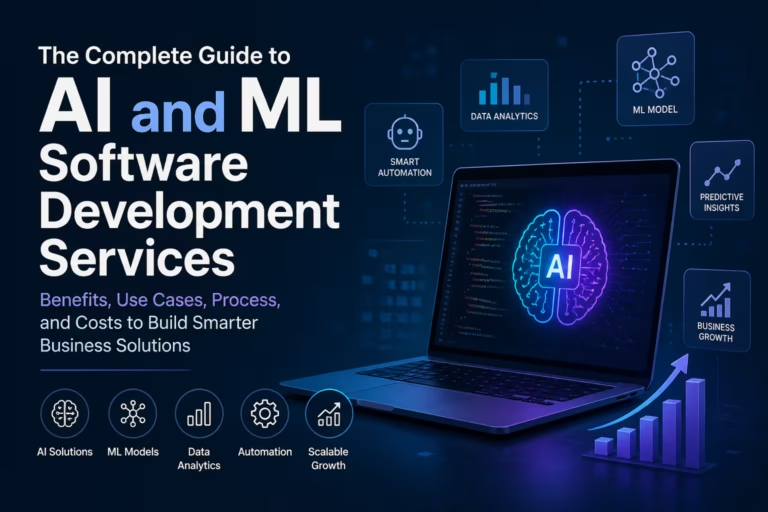
Also Read: What Are AI and ML Software Development Services? A Complete Business Guide
Key Takeaways
- NLP software development enables businesses to process and analyze human language at scale.
- Organizations use NLP to automate customer support, document processing, compliance monitoring, and data extraction.
- NLP software development for business reduces manual workloads while improving efficiency and accuracy.
- Industries such as FinTech, Healthcare, Logistics, Manufacturing, and EdTech are rapidly adopting NLP-powered solutions.
- Modern NLP applications support capabilities such as sentiment analysis, semantic search, conversational AI, and intelligent document processing.
- Custom NLP solutions offer greater flexibility and scalability than generic off-the-shelf tools.
- Businesses that invest in NLP can improve customer experiences, accelerate decision-making, and unlock valuable insights from unstructured data.
NLP Software Development at a Glance
| Category | Details |
| Technology | Natural Language Processing (NLP) |
| Primary Purpose | Understand and process human language |
| Key Benefits | Automation, efficiency, and business insights |
| Common Use Cases | Customer support, document processing, compliance monitoring |
| Industries | FinTech, Healthcare, Logistics, EdTech, Manufacturing |
| Business Impact | Reduced manual work and faster decision-making |
Gartner estimates that 80% to 90% of enterprise data is unstructured, making technologies like NLP essential for analyzing and extracting value from large volumes of text-based information.
What Is NLP Software Development?
NLP software development is the process of creating applications that can understand, analyze, interpret, and process human language. Using artificial intelligence (AI) and machine learning (ML), Natural Language Processing enables software systems to work with text and speech in ways that help businesses automate language-based tasks.
Unlike traditional software that relies on structured data and predefined rules, NLP solutions can process unstructured information such as emails, customer reviews, support tickets, contracts, reports, and conversations. This allows organizations to extract insights, improve efficiency, and reduce manual workloads.
For example, an NLP-powered system can automatically classify customer inquiries, analyze sentiment in reviews, extract information from documents, or summarize lengthy reports. These capabilities help businesses make faster decisions while improving accuracy and productivity.
Modern NLP software development goes far beyond simple keyword matching. Advanced NLP systems can understand context, identify intent, recognize entities, and generate meaningful responses. As businesses continue to generate increasing amounts of unstructured data, NLP has become an essential technology for supporting digital transformation initiatives.
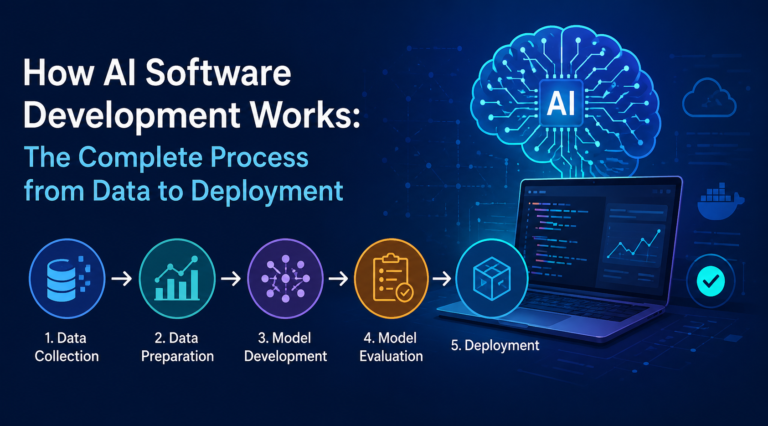
Also Read: How AI Software Development Works: The Complete Process from Data to Deployment
Why NLP Software Development for Business Matters
Businesses today handle more unstructured data than ever before. Customer emails, support tickets, contracts, surveys, reports, and social media interactions contain valuable information, but manually processing this data is often slow, costly, and inefficient.
This is where NLP software development for business is making a significant impact. By enabling systems to understand and process human language, NLP helps organizations automate repetitive tasks, reduce operational bottlenecks, and uncover insights that would otherwise remain hidden within large volumes of text.
For many organizations, improving operational efficiency is a top priority. NLP-powered solutions can automatically categorize customer inquiries, extract key information from documents, analyze customer sentiment, and identify trends across thousands of interactions. This reduces manual effort while allowing employees to focus on higher-value work.
NLP is also helping businesses improve customer experiences. Intelligent chatbots, virtual assistants, and automated support systems provide faster responses, handle routine inquiries, and ensure consistent communication across multiple channels.
As digital transformation initiatives continue to accelerate, organizations are increasingly looking for ways to convert unstructured data into actionable intelligence. NLP provides the foundation for smarter automation, better decision-making, and scalable business operations.
Companies that invest in NLP solutions today are not only improving productivity but also gaining a competitive advantage in an increasingly data-driven business environment.
How Natural Language Processing Is Transforming Business Operations
Organizations across industries are using NLP to automate workflows, improve efficiency, and gain more value from their data. Here are some of the most impactful business applications.
Automating Customer Support and Service
NLP-powered chatbots and support systems can classify inquiries, route tickets, and answer common questions automatically. This helps businesses reduce response times and improve customer satisfaction.
Streamlining Document Processing and Data Extraction
Businesses can use NLP to extract information from invoices, contracts, forms, and reports without manual review. This improves accuracy while reducing administrative workloads.
Enhancing Compliance and Risk Management
NLP helps organizations analyze documents, monitor communications, and identify potential compliance risks more efficiently, particularly in highly regulated industries.
Improving Internal Knowledge Management
Employees can use NLP-powered search tools to quickly locate information across emails, documents, and knowledge bases, improving productivity and collaboration.
Turning Customer Feedback into Actionable Insights
NLP analyzes reviews, surveys, and social media conversations to identify customer sentiment, recurring concerns, and emerging trends that support better business decisions.
Real-World NLP Applications Across Industries
The adoption of NLP is accelerating across industries as organizations seek more efficient ways to process information, improve customer experiences, and automate language-driven workflows. While the use cases vary, the goal remains the same: transforming unstructured data into valuable business intelligence.
FinTech
Financial institutions handle large volumes of applications, customer communications, compliance documents, and transaction records. NLP solutions help automate document verification, analyze customer inquiries, detect potential fraud indicators, and streamline onboarding processes.
Healthcare
Healthcare providers generate vast amounts of clinical notes, patient records, insurance documents, and medical reports. NLP applications can extract relevant information, organize medical data, support clinical documentation, and improve access to critical patient information.
Transportation and Logistics
Logistics companies manage shipment updates, customer communications, delivery instructions, and operational reports daily. NLP-powered systems can automate support requests, analyze shipment-related communications, and improve information flow across supply chains.
EdTech
Educational institutions and learning platforms use NLP to analyze student feedback, support personalized learning experiences, and automate content organization.
Manufacturing
Manufacturers often rely on maintenance logs, quality reports, inspection documents, and operational records. NLP solutions can analyze this information, identify recurring issues, and support data-driven decision-making.
As businesses generate increasing volumes of emails, support requests, contracts, and operational documents, manually extracting meaningful insights becomes more challenging. NLP helps organizations analyze this unstructured data at scale, enabling faster decision-making, improved efficiency, and more informed business strategies.
NLP Applications by Industry
| Industry | Common NLP Applications |
| FinTech | Fraud Detection, Loan Processing, Customer Onboarding |
| Healthcare | Clinical Documentation, Medical Records Analysis |
| Transportation & Logistics | Shipment Communication Analysis, Customer Support Automation |
| EdTech | Student Feedback Analysis, Personalized Learning |
| Manufacturing | Maintenance Reports, Quality Documentation Analysis |
Essential Features of Modern NLP Solutions
Modern NLP applications help businesses process language more effectively, automate workflows, and generate actionable insights from unstructured data. While capabilities vary depending on business requirements, several core features form the foundation of successful NLP solutions.
Named Entity Recognition (NER)
Named Entity Recognition identifies and classifies important information within text, such as names, organizations, locations, dates, and monetary values. Businesses use this capability to automate data extraction and improve document processing workflows.
Sentiment Analysis
Sentiment analysis helps organizations understand the emotions and opinions expressed in customer reviews, surveys, social media posts, and support interactions. This enables businesses to measure customer satisfaction and identify areas for improvement.
Text Classification
Text classification automatically categorizes content based on predefined criteria. Common use cases include support ticket routing, email categorization, content moderation, and document organization.
Information Extraction
Information extraction enables NLP systems to identify and retrieve specific details from contracts, invoices, reports, forms, and other documents. This reduces manual data entry and improves operational efficiency.
Conversational AI
Conversational AI powers chatbots, virtual assistants, and automated support systems. These solutions help businesses provide faster responses, improve customer engagement, and deliver consistent service experiences across multiple channels.
Semantic Search
Unlike traditional keyword-based search systems, semantic search understands context and intent. This helps employees and customers find relevant information more quickly, improving productivity and user experiences.
Multilingual Language Processing
For global organizations, multilingual NLP capabilities support communication across different languages and regions. This allows businesses to serve diverse customer bases while maintaining consistency in operations and customer interactions.
Benefits of NLP Software Development for Businesses
Organizations investing in NLP software development are doing more than adopting a new technology. They are creating opportunities to improve efficiency, reduce costs, and make better business decisions.
Increased Operational Efficiency
NLP automates repetitive language-based tasks that would otherwise require significant manual effort. From processing customer inquiries to extracting information from documents, businesses can streamline workflows and complete tasks more quickly.
Reduced Manual Workloads
Many organizations spend countless hours reviewing emails, contracts, reports, and support tickets. NLP solutions can automate these processes, allowing employees to focus on strategic and higher-value activities rather than routine administrative work.
Enhanced Customer Experiences
Businesses can use NLP-powered chatbots, virtual assistants, and sentiment analysis tools to deliver faster responses and more personalized customer interactions. This helps improve customer satisfaction while maintaining consistent service quality.
Faster and More Informed Decision-Making
NLP systems can analyze large volumes of text data and identify patterns, trends, and insights that might otherwise go unnoticed. This enables leaders to make informed decisions based on real-time information.
Improved Compliance and Risk Management
Organizations operating in regulated industries can use NLP to monitor communications, analyze documentation, and identify potential compliance risks.
Scalability and Long-Term Cost Savings
As businesses grow, manually processing increasing amounts of information becomes unsustainable. NLP solutions scale with business needs, helping organizations manage larger workloads without proportionally increasing operational costs.
Common Challenges in NLP Software Development
While NLP offers significant business benefits, successful implementation requires careful planning and execution.
Data Quality and Availability
NLP systems rely on high-quality data to deliver accurate results. Incomplete, inconsistent, or poorly structured data can affect model performance and reduce effectiveness.
Industry-Specific Language Complexity
Different industries use unique terminology, abbreviations, and communication patterns. Generic NLP models may struggle to understand specialized language used in sectors such as finance, healthcare, legal services, or logistics.
Privacy and Security Concerns
Many NLP applications process sensitive information, including customer records, financial documents, and confidential communications. Organizations must implement strong security measures and comply with industry regulations.
Integration with Existing Systems
Businesses often need NLP solutions to work alongside CRM platforms, ERP systems, document management tools, and other business applications. Ensuring seamless integration requires careful planning.
Model Accuracy and Continuous Improvement
Language evolves continuously, and business requirements change over time. NLP models require ongoing monitoring, testing, and optimization to maintain accuracy.
Custom NLP Software vs Off-the-Shelf NLP Tools
Businesses looking to implement NLP capabilities often face an important decision: build a custom NLP solution or adopt an off-the-shelf tool.
| Custom NLP Software Development | Off-the-Shelf NLP Tools |
| Designed around specific business workflows | Built for general use cases |
| Greater flexibility and customization | Limited customization options |
| Easier integration with existing systems | Integration capabilities may vary |
| Can be trained on industry-specific data | Typically uses generalized models |
| Full control over features and data handling | Dependent on vendor capabilities |
| Scales according to business requirements | Scaling options depend on the provider |
Off-the-shelf NLP tools can be suitable for organizations with basic requirements and limited customization needs. However, businesses with complex workflows, compliance requirements, or industry-specific terminology often benefit more from custom NLP software development.
How Bytexus Builds Scalable NLP Solutions
Successful NLP implementation requires more than selecting the right technology. It involves understanding business objectives, preparing quality data, developing accurate models, and ensuring seamless integration with existing systems.
With 12+ years of software development experience, 135+ global clients, and expertise across 25+ industries, Bytexus helps businesses design and develop custom NLP solutions that address real operational challenges and support long-term growth.
Business Discovery and Strategy
Every project begins with understanding the organization’s goals, workflows, data sources, and operational requirements. This helps identify where NLP can deliver the greatest business value.
Data Preparation and Analysis
The quality of an NLP solution depends heavily on the quality of the data it processes. Our team evaluates, organizes, and prepares relevant datasets for training and optimization.
Custom Model Development
Based on project requirements, we develop NLP models capable of performing tasks such as document processing, sentiment analysis, information extraction, text classification, semantic search, and conversational AI.
System Integration
NLP solutions are integrated with CRM platforms, ERP systems, customer support tools, and document management systems to ensure seamless adoption.
Testing, Deployment, and Optimization
Before deployment, solutions undergo extensive testing to evaluate performance, accuracy, security, and scalability. Continuous monitoring helps ensure long-term effectiveness.
Future Trends Shaping NLP Software Development
As artificial intelligence continues to evolve, NLP capabilities are becoming more advanced and business-focused.
Large Language Models (LLMs)
Large Language Models are significantly improving how NLP systems understand context, generate responses, summarize information, and support complex workflows.
Agentic AI Systems
Businesses are beginning to adopt AI systems capable of performing tasks autonomously with minimal human intervention. Combining NLP with reasoning capabilities enables smarter automation.
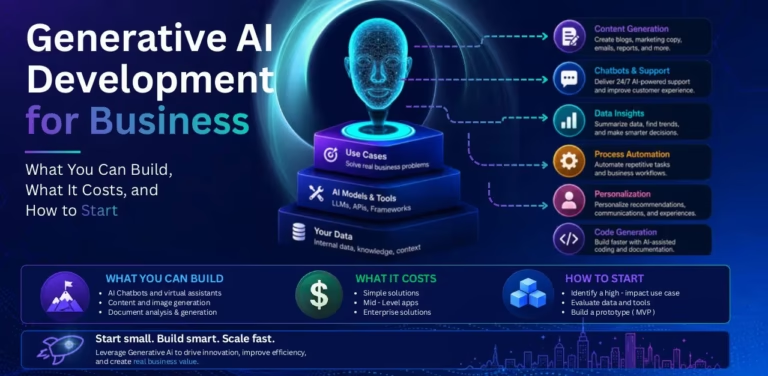
Explore More: Generative AI Development for Business: What You Can Build, What It Costs, and How to Start
Industry-Specific Language Models
Organizations are increasingly investing in models trained on industry-specific data. These solutions better understand terminology, regulations, and workflows unique to individual sectors.
Enterprise AI Assistants
AI-powered assistants are becoming valuable tools for employees across departments. By combining NLP, semantic search, and organizational knowledge, these assistants improve productivity and information access.
Conclusion
NLP software development is transforming how organizations process information, automate workflows, and make decisions. From customer support automation and intelligent document processing to compliance monitoring and knowledge management, NLP enables businesses to unlock greater value from their data.
As the volume of unstructured information continues to grow, NLP software development for business is becoming a critical component of digital transformation strategies. Organizations that invest in NLP solutions can improve operational efficiency, reduce manual workloads, enhance customer experiences, and make faster, data-driven decisions.
Whether you’re exploring NLP for document processing, sentiment analysis, conversational AI, or enterprise knowledge management, the right solution can create measurable business impact and long-term competitive advantages.
At Bytexus, we help organizations design, develop, and scale custom NLP solutions tailored to their unique business requirements. With expertise across AI, machine learning, cloud technologies, and enterprise software development, our team helps businesses unlock the full potential of Natural Language Processing and AI-driven automation.
Frequently Asked Questions (FAQs)
What is NLP software development?
NLP software development is the process of building applications that can understand, analyze, interpret, and generate human language. Businesses use NLP solutions to automate customer support, document processing, sentiment analysis, and information extraction.
How is NLP used in business operations?
Businesses use NLP to automate customer interactions, process documents, analyze feedback, improve knowledge management, monitor compliance, and extract insights from unstructured data.
What industries benefit most from NLP solutions?
NLP is widely used across FinTech, Healthcare, Transportation and Logistics, Manufacturing, EdTech, Insurance, Retail, and Customer Service industries.
What is the difference between NLP and Generative AI?
NLP focuses on understanding and processing human language, while Generative AI creates new content such as text, images, or code.
How can NLP improve customer service?
NLP improves customer service through chatbots, virtual assistants, ticket classification, sentiment analysis, and intelligent routing.
Should businesses choose custom NLP software or off-the-shelf tools?
The right choice depends on business requirements. Custom NLP software offers greater flexibility and scalability, while off-the-shelf tools may suit simpler use cases.
How long does it take to develop an NLP solution?
Development timelines vary depending on complexity, data availability, integrations, and business objectives. Simple solutions may take weeks, while enterprise-grade systems may require several months.
Why is NLP important for digital transformation?
NLP helps organizations automate language-based processes, unlock insights from unstructured data, improve efficiency, and enhance customer experiences.